
When I look at older commercial streets in China, I can still see the era when stone cladding was the default choice for buildings that wanted to look solid and expensive. My family once worked around the stone business, so this shift is not abstract to me. The market changed because contractors, owners and designers started making a more practical calculation: what material gives a reliable facade with lower risk, faster installation and easier maintenance?
The Change Is Not Only Happening in China
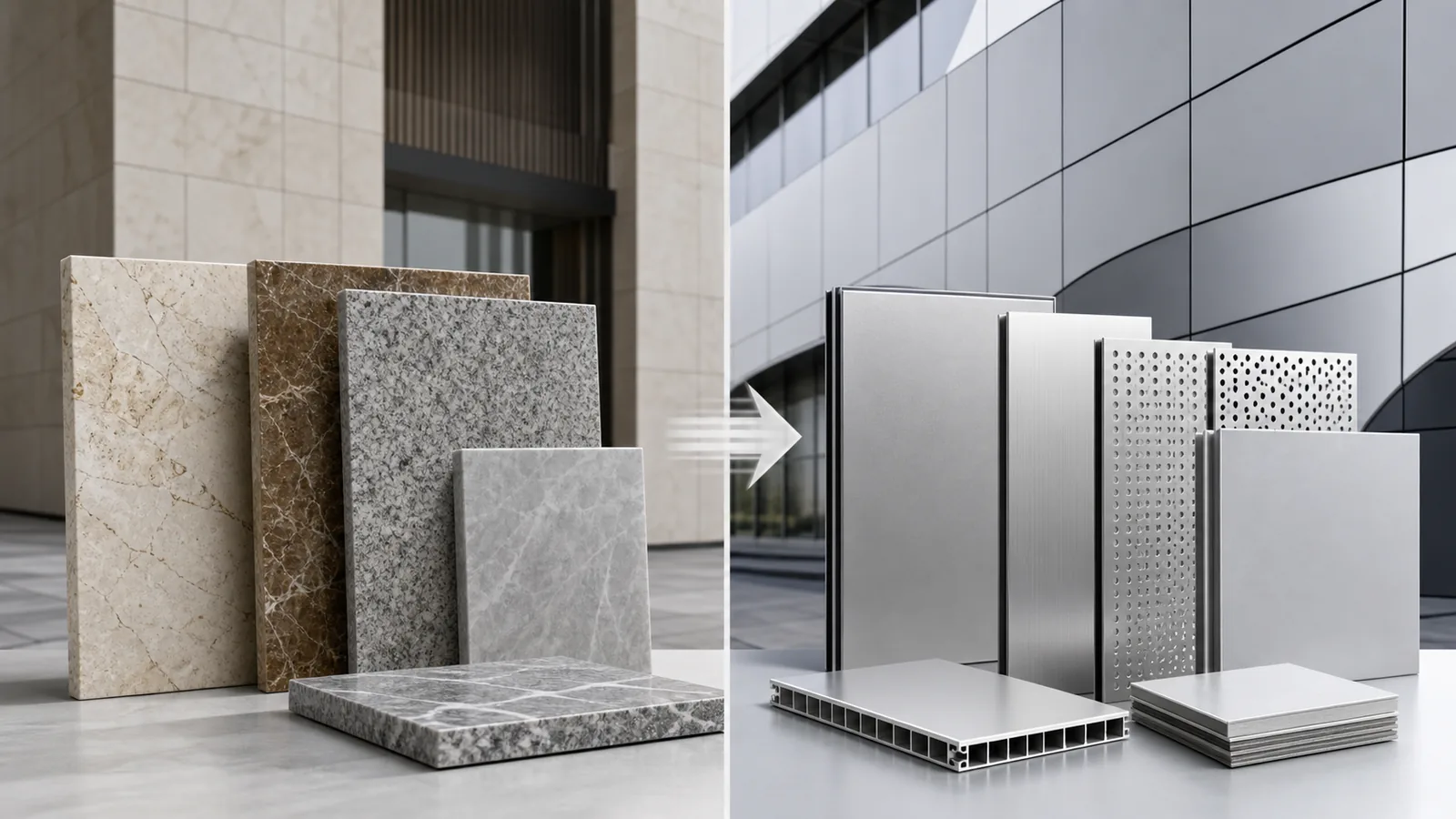
What This Market Shift Means for Buyers
The stone-to-aluminum shift does not mean stone has no value. It means more projects now care about weight, installation speed, maintenance and repeatable factory fabrication. Buyers should match material choice to project reality.
| Buyer checkpoint | What to confirm before quotation |
|---|---|
| Weight limit | Check whether the building or substrate can carry heavy cladding. |
| Installation speed | Factory-fabricated panels can reduce site cutting and wet work. |
| Maintenance | Metal panels are easier to replace in modular areas. |
| Design intent | Stone texture can still be simulated with printed or coated aluminum finishes. |
Useful next pages: Aluminum Solid Panel Surface Finishes Contact
The same trend appears in shopping centers, subway stations, airports, offices and public buildings. Natural stone still has value for certain luxury interiors, but on many exterior facades it creates weight, anchoring, color consistency and safety concerns. Aluminum solid panels and honeycomb panels offer a lighter, more controllable alternative.
Why Project Owners Move Away from Stone
The biggest reason is not fashion. It is risk control. Stone needs careful anchoring, grading and installation. If the substrate, brackets or stone quality are wrong, repairs are expensive. Aluminum panels are fabricated by drawing, folded at the edge, finished before delivery and installed with a more predictable subframe system.
Where Aluminum Panels Win
- Lower dead load on the building structure.
- More stable color and finish control across batches.
- Curved, perforated and custom-shaped options.
- Faster replacement if one panel is damaged.
- Better compatibility with modern curtain wall detailing.
Stone Is Not Disappearing, But Its Role Is Changing
Stone is still attractive where natural texture is the main value. The difference is that many projects now use stone-look aluminum finishes or stone-faced honeycomb panels when they need the appearance of stone with less weight. That is why the material conversation has moved from “what looks expensive” to “what performs reliably over the full project life”.
What to Send for a Quotation
For project-based supply, the most useful inquiry information is product type, size or drawing, finish requirement, quantity, destination port and any reference photos. This helps us check the suitable material structure before quoting.
How This Affects Overseas Buyers
For importers and contractors, the shift from stone to aluminum is not only about appearance. It changes packing, loading, installation labor and after-sales risk. Stone usually needs heavier crates and stronger on-site lifting. Aluminum panels are easier to label by elevation, pack by project zone and replace if one area is damaged during installation.
Specification Points That Matter
| Panel type | Solid aluminum panel, honeycomb panel or stone-look finish panel |
| Finish | PVDF, powder coating, wood grain, stone look or anodized finish |
| Substructure | Aluminum profile, steel frame, brackets and fixing method |
| Risk control | Color sample, shop drawing, packing list and spare panels |
Common Mistakes
A common mistake is asking only for a square-meter price. That ignores edge folding, stiffeners, perforation, coating grade, packing method and drawing work. Another mistake is comparing natural stone and aluminum panels as if they serve the same installation logic. In real projects, the fixing system and long-term maintenance cost can change the total result.
FAQ
Can aluminum panels fully replace stone?
Not in every project. Stone is still useful for premium natural texture, but aluminum panels often perform better for lightweight exterior cladding and repeatable modern facades.
Is stone-look aluminum acceptable for high-end buildings?
Yes, if the finish sample is approved and the panel system is properly detailed. Many projects use stone-look finishes to reduce weight and installation risk.