
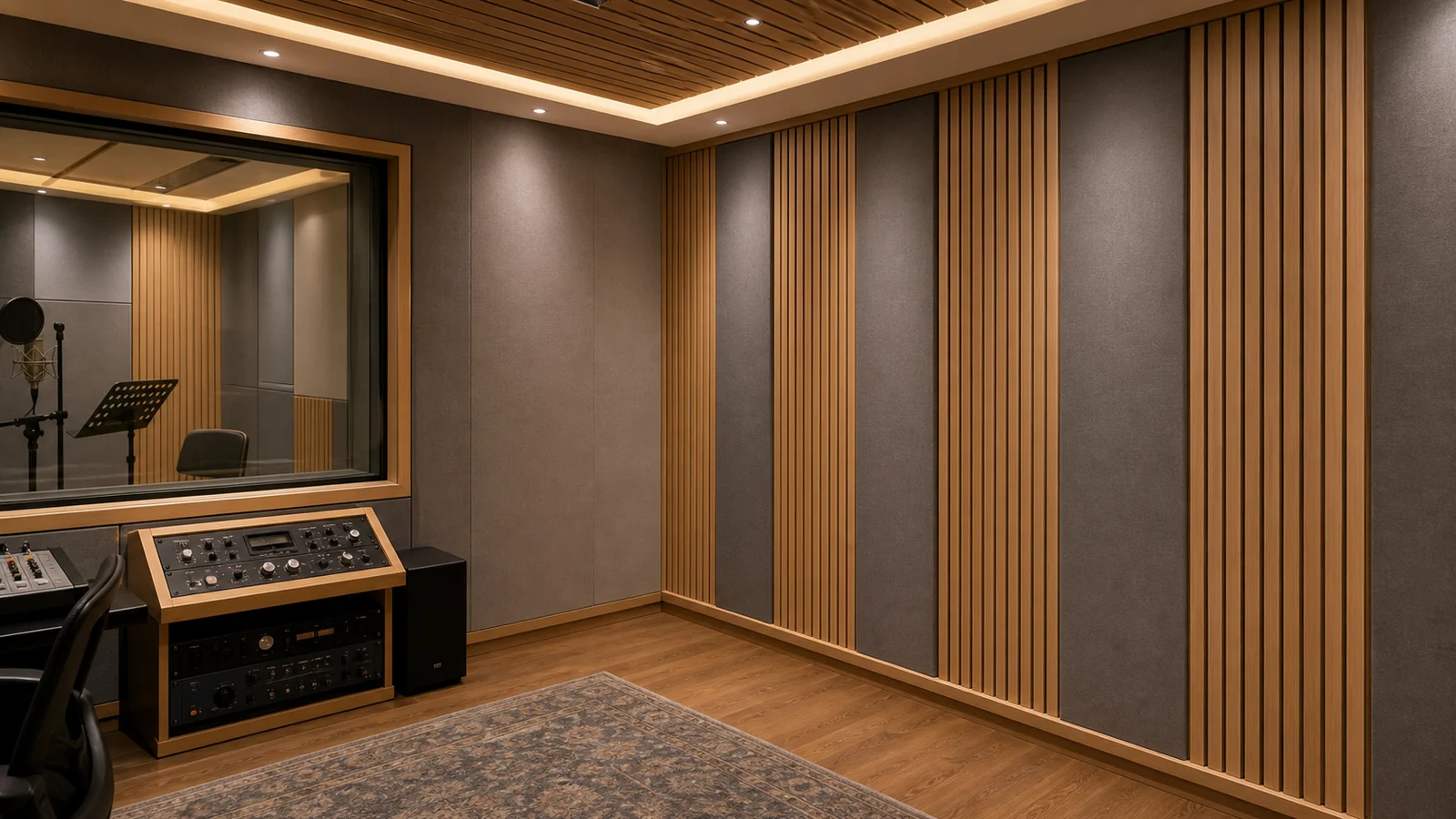
Acoustic wall panel is a decorative sound-absorbing wall system used to reduce echo, control reverberation, and improve indoor sound comfort.
It is commonly used in KTV rooms, bars, recording studios, music rooms, hotel meeting rooms, office conference rooms, cinemas, schools, and commercial interiors.
For overseas contractors, distributors, and project buyers, acoustic wall panels are useful when a project needs both sound control and interior decoration.
Quick Buyer Summary
| Item | Recommendation |
|---|---|
| Best for | KTV rooms, studios, hotels, offices, cinemas, bars, music rooms |
| Main advantage | Reduces echo and improves indoor sound comfort |
| Common core material | Polyester fiber, fiberglass, rock wool, acoustic felt, or composite core |
| Surface options | Wood slat, fabric finish, melamine finish, perforated surface, groove surface |
| Typical thickness | 9mm / 12mm / 15mm / 18mm / 20mm / 21mm depending on type |
| Acoustic performance | NRC depends on material, thickness, air cavity, and installation method |
| Buyer should confirm | Acoustic target, material type, thickness, finish, installation method, quantity |
What Is Acoustic Wall Panel?
Acoustic wall panel is an interior wall material designed to absorb sound energy and reduce reverberation inside a room.
Unlike ordinary decorative wall panels, acoustic panels are not only used for appearance. Their main purpose is to improve sound quality by reducing reflected sound.
In commercial interiors, this can help improve:
- Music experience in KTV and bars
- Speech clarity in meeting rooms
- Sound comfort in hotels and offices
- Echo control in studios and classrooms
- Interior decoration effect
It is not a complete soundproof wall by itself. Acoustic panels mainly absorb indoor sound reflection, while soundproofing usually requires a complete wall system with mass, sealing, insulation, and structural design.
Product Structure and Material Composition
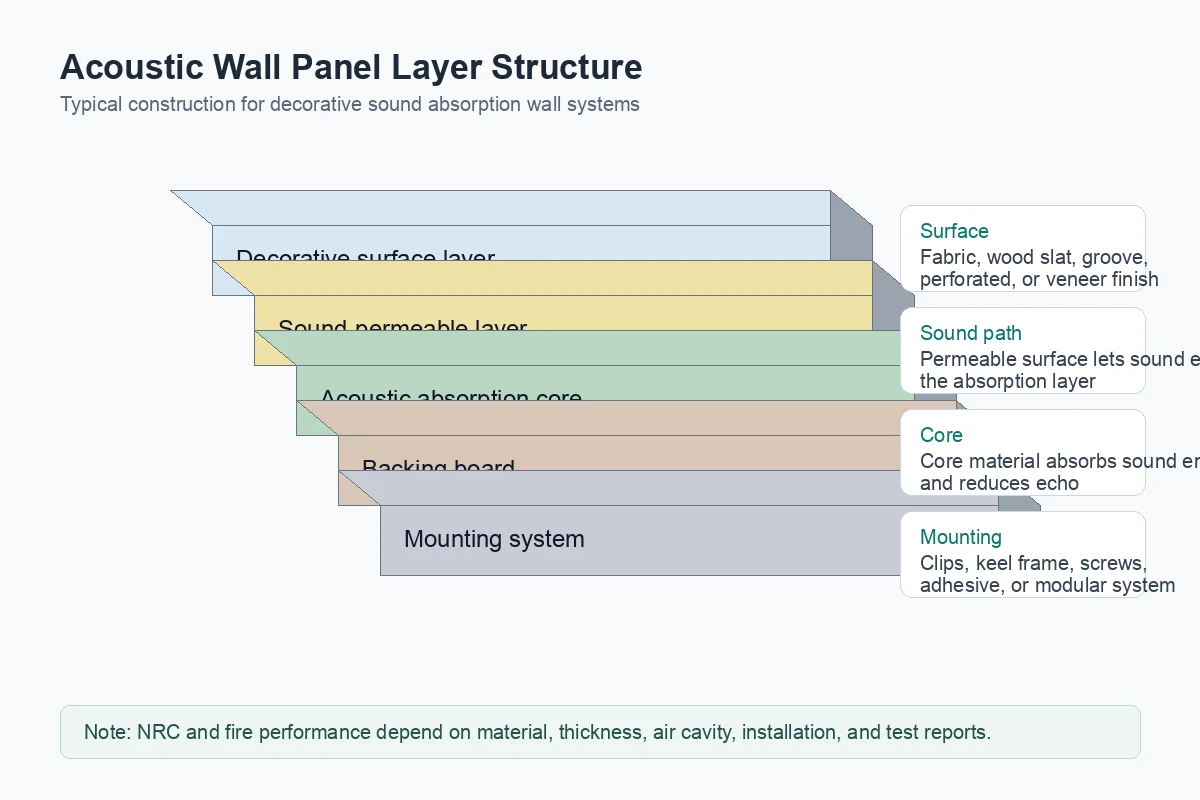
A typical acoustic wall panel may include the following layers:
| Layer | Function |
|---|---|
| Decorative surface layer | Provides fabric, wood, slat, groove, or commercial interior appearance |
| Sound-permeable layer | Allows sound waves to enter the absorption material |
| Acoustic absorption core | Absorbs sound energy and reduces echo |
| Backing board | Improves panel stability and installation strength |
| Mounting system | Fixes panel to wall or ceiling surface |
The absorption core is the key part of the system. Common materials include polyester fiber, fiberglass, rock wool, acoustic felt, and composite acoustic materials.
Key Engineering Performance
| Property | Typical Value / Description |
|---|---|
| Acoustic function | Sound absorption and reverberation control |
| NRC range | Commonly 0.6-0.95 depending on material and installation |
| Common thickness | 9mm / 12mm / 15mm / 18mm / 20mm / 21mm |
| Common width | 132mm / 200mm / 600mm or custom depending on type |
| Common length | 2440mm or custom |
| Surface options | Fabric, wood slat, melamine, perforated, groove, decorative veneer |
| Fire performance | Project must confirm fire rating and test report |
| Installation | Adhesive, clips, keel frame, screws, or modular system |
| Application | KTV, studios, offices, hotels, cinemas, schools, bars |
Commercial Application Scenarios
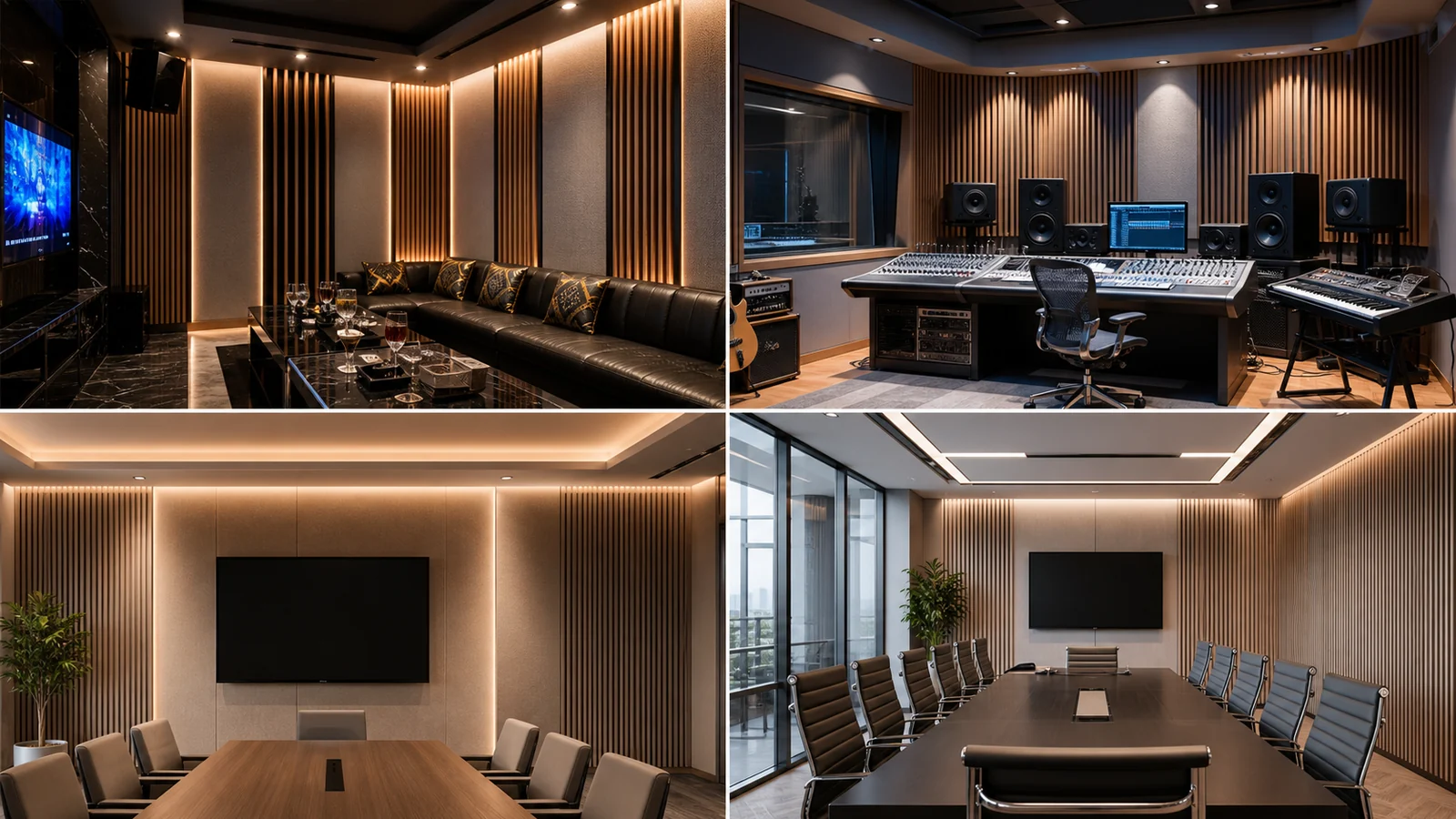
Acoustic wall panels are mainly used where echo control and decorative interior design are both required.
| Project Type | Suitability | Reason |
|---|---|---|
| KTV room | Excellent | Improves music experience and reduces echo |
| Recording studio | Excellent | Helps control sound reflection |
| Hotel meeting room | Excellent | Improves speech clarity and room comfort |
| Office conference room | High | Reduces echo during meetings |
| Cinema | High | Supports better indoor sound control |
| Bar or entertainment space | High | Improves sound comfort and decorative effect |
| School classroom | Medium to high | Improves speech clarity |
| Residential bedroom | Medium | Useful when echo control or decoration is needed |
| Exterior facade | Not recommended | Acoustic wall panels are mainly for interior use |
Installation System and Project Details
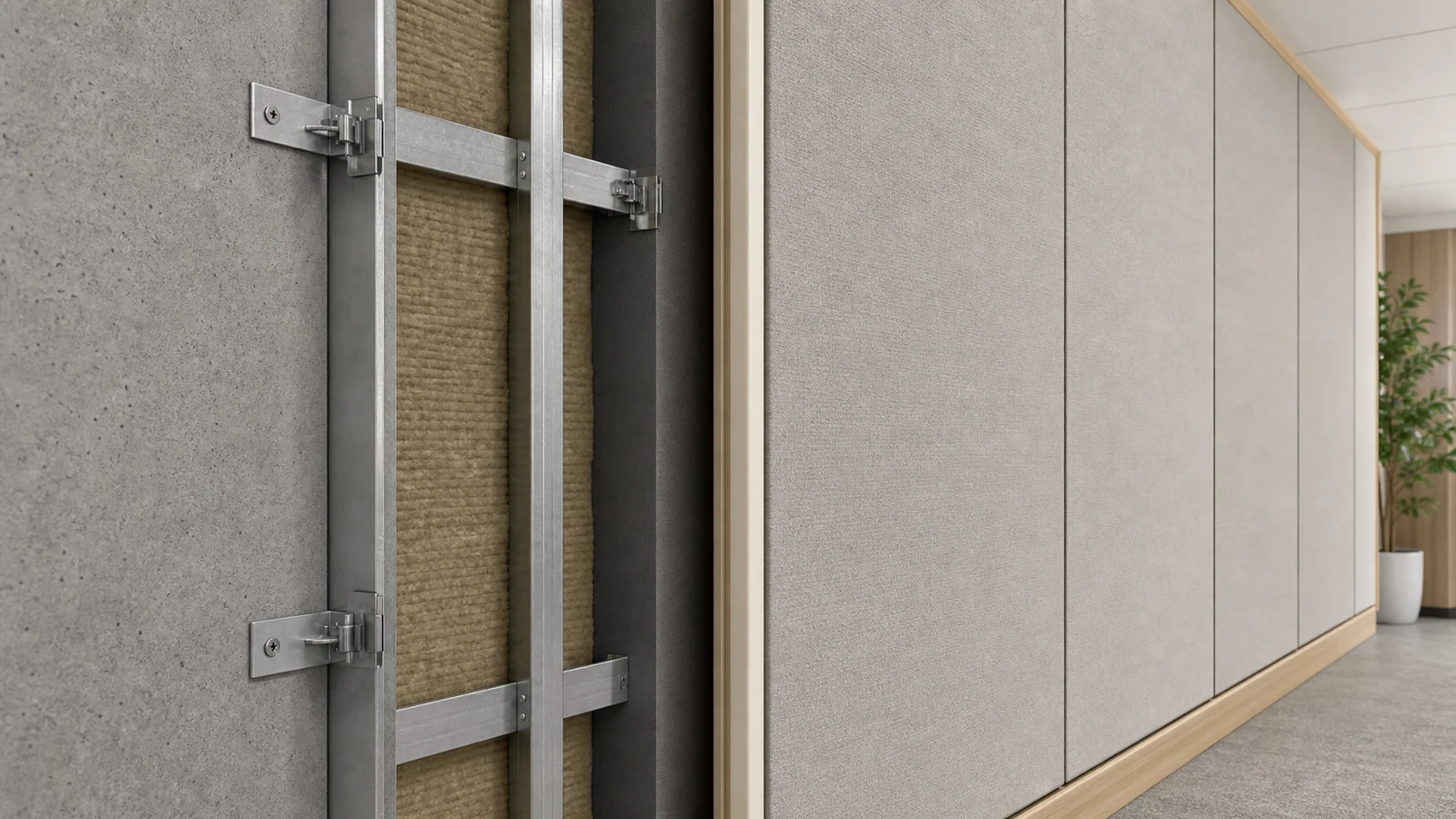
Acoustic wall panel installation should consider room function, wall condition, panel thickness, air cavity, and fixing method.
1. Direct Wall Installation
This method is suitable for flat interior walls and decorative acoustic projects.
Key points:
- Wall surface should be clean and stable
- Adhesive or screws may be used depending on product type
- Panel layout should be planned before installation
- Joint alignment affects final appearance
2. Keel Frame Installation
This method is suitable when acoustic performance needs improvement or the wall surface is uneven.
Key points:
- Air cavity can improve sound absorption performance
- Keel frame helps control wall flatness
- More suitable for studios, KTV rooms, and commercial rooms
- Installation cost is higher than direct wall installation
3. Modular Acoustic System
This method is used for larger commercial interiors.
Key points:
- Better panel replacement and layout control
- Suitable for hotel meeting rooms, offices, cinemas, and public spaces
- Requires accurate measurement and design coordination
Common Project Risks
Many acoustic wall panel problems come from misunderstanding the difference between sound absorption and soundproofing.
Common risks include:
- Buyer expects soundproofing but only buys sound-absorbing panels
- NRC value is not confirmed by test report
- Panel thickness is too thin for the room requirement
- Air cavity is ignored when better absorption is needed
- Fire rating requirement is not confirmed before public project use
- Different production batches cause slight color difference
- Installation layout is not planned before order
- Edge trim and closing detail are missing from quotation
- Photos are used for color confirmation without physical sample
For studios, KTV rooms, cinemas, and meeting rooms, acoustic design should be considered before material purchase.
How to Choose Between Acoustic Wall Panel and Other Wall Panels
| Material | Best Use | Main Advantage |
|---|---|---|
| Acoustic wall panel | KTV, studios, hotels, offices | Sound absorption and decorative design |
| Anti-collision wall panel | Hospitals, schools, public corridors | Better impact resistance and wall protection |
| Ice-Fire Board | Hospitals, labs, public interiors | Fire-resistant substrate and easy-clean surface |
| Nano Diamond Panel | Commercial corridors and malls | Higher surface hardness and scratch resistance |
| SPC Wall Panel | Bathrooms, kitchens, wet interiors | Waterproof and dimensionally stable |
| Bamboo Fiber Wall Panel | Budget interior renovation | Cost-effective and fast installation |
Choose acoustic wall panel when echo control, speech clarity, music experience, or room sound comfort is important.
Do not choose acoustic panel only because it looks decorative. For ordinary wall decoration without sound requirements, bamboo fiber panels, SPC wall panels, or nano diamond panels may be more suitable.
What Buyers Should Confirm Before Quotation
Before requesting a quotation, please prepare the following information:
- Project type: KTV, studio, hotel, office, cinema, school, bar, etc.
- Room size and wall area in square meters
- Acoustic target: echo reduction, speech clarity, music room, studio, etc.
- Required material type: polyester fiber, fiberglass, rock wool, wood slat, fabric panel, etc.
- Required thickness
- Surface finish and color
- Fire rating or test report requirement
- Installation method: adhesive, screws, clips, keel frame, or modular system
- Edge trim and joint detail requirement
- Packing requirement
- Destination country and port
- Sample requirement before bulk order
Clear information helps suppliers quote accurately and prevents misunderstanding between different acoustic panel systems.
FAQ
What is an acoustic wall panel?
It is a decorative sound-absorbing panel used to reduce echo and improve indoor sound comfort in commercial and residential interiors.
Is acoustic wall panel the same as soundproof panel?
No. Acoustic wall panels mainly absorb indoor sound reflection. Soundproofing requires a complete wall system with mass, sealing, insulation, and structural design.
Can acoustic wall panels be used in KTV rooms?
Yes. KTV rooms are one of the common applications because acoustic panels help control echo and improve music experience.
What does NRC mean?
NRC means Noise Reduction Coefficient. A higher NRC usually means better sound absorption, but final performance depends on product type and installation method.
Can acoustic panels be used in offices?
Yes. Office meeting rooms and conference rooms often use acoustic panels to improve speech clarity and reduce echo.
What information is needed for quotation?
Buyers should provide project type, room size, wall area, acoustic target, material type, thickness, surface finish, installation method, fire rating requirement, and destination port.
Internal Links
Request a Quotation
If you are sourcing acoustic wall panels for a KTV, studio, hotel, office, cinema, school, or commercial interior project, please send us your project details.
Please include:
- Project type
- Room size
- Wall area
- Acoustic target
- Required thickness
- Surface finish
- Installation method
- Destination country
We can help check suitable specifications, surface options, packing method, and factory quotation.