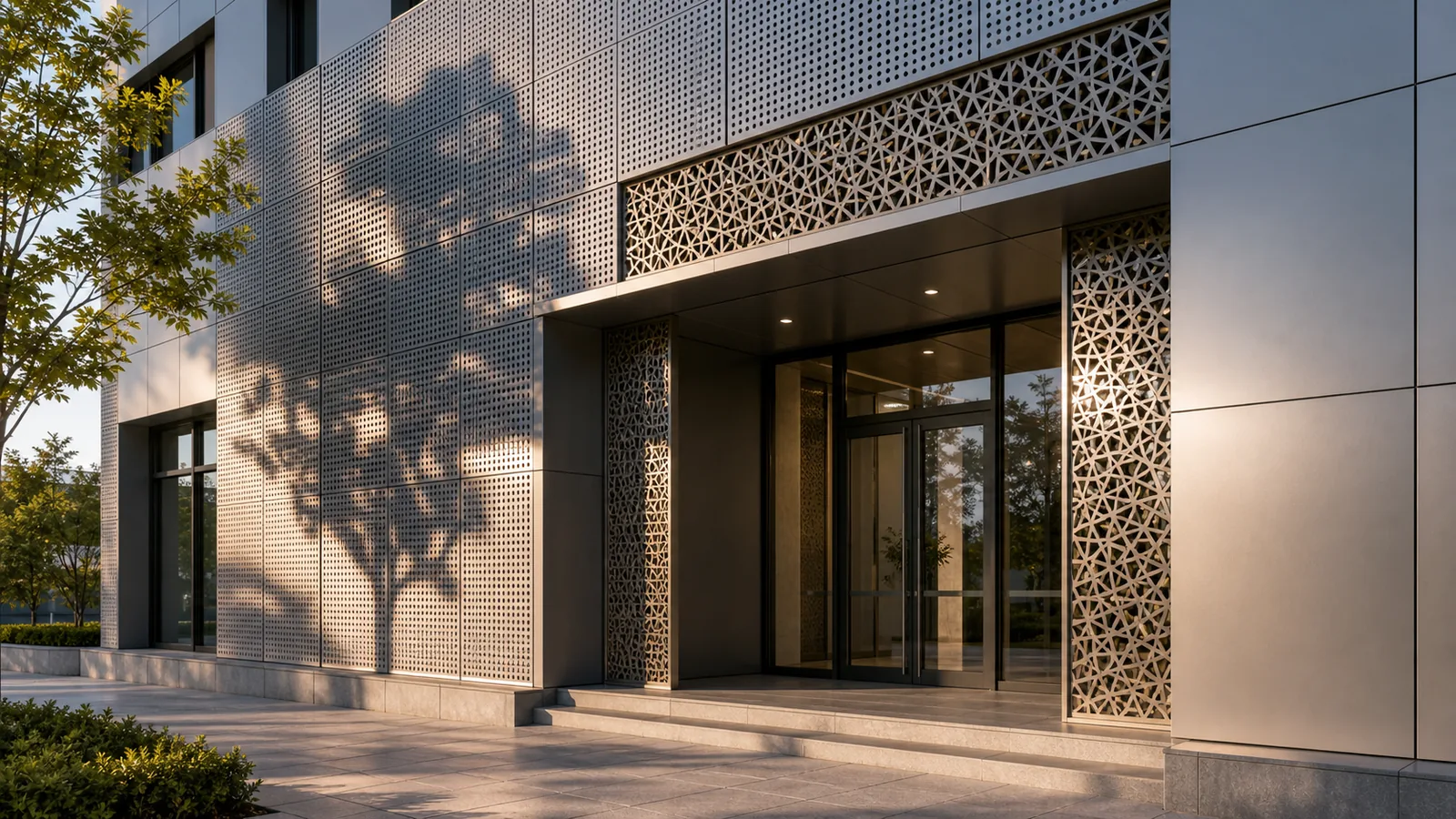
Perforated aluminum panels and carved aluminum panels are decorative architectural metal panels used for facades, screens, ceilings, sunshades, privacy panels, commercial walls, and building entrances.
They are usually made from aluminum solid sheet. The sheet can be punched, CNC cut, laser cut, folded, welded, coated, and installed with a metal subframe according to project drawings.
For overseas contractors, distributors, architects, and project buyers, these panels are useful when a building needs both decorative appearance and practical functions such as ventilation, shading, privacy control, and facade identity.
Quick Buyer Summary
| Item | Perforated Aluminum Panel | Carved Aluminum Panel |
|---|---|---|
| Main process | Punching or CNC perforation | CNC cutting or laser cutting |
| Best for | Facades, ceilings, ventilation panels, sunshades, acoustic or decorative panels | Decorative screens, privacy panels, hotel facades, feature walls |
| Pattern style | Round holes, square holes, slots, custom hole patterns | Geometric, floral, cultural, abstract, custom drawings |
| Main advantage | Ventilation, shading, lower visual weight, repeatable pattern | Strong decorative effect and custom design identity |
| Typical material | Aluminum solid sheet | Aluminum solid sheet |
| Buyer should confirm | Thickness, hole size, open area ratio, pattern, coating, edge return, fixing system | Thickness, drawing file, pattern scale, coating, edge return, fixing system |
What Is Perforated Aluminum Panel?
Perforated aluminum panel is an aluminum solid sheet processed with holes or slots through punching, CNC perforation, or similar fabrication methods.
The holes can be round, square, rectangular, slotted, triangular, or customized according to project design.
Common applications include:
- Building facade screens
- Ventilation facade panels
- Sunshade panels
- Ceiling panels
- Parking garage facade panels
- Acoustic decorative panels
- Interior decorative metal panels
- Equipment enclosure panels
Perforated aluminum panel is often selected when the project needs a balance of decoration, ventilation, sunlight control, and lower visual weight.
What Is Carved Aluminum Panel?
Carved aluminum panel is an aluminum solid sheet processed with decorative cut-out patterns.
It is often made through CNC cutting or laser cutting according to CAD drawings. The patterns can be geometric, floral, cultural, abstract, landscape-inspired, or fully customized.
Common applications include:
- Hotel decorative screens
- Commercial building entrance screens
- Privacy screens
- Garden or courtyard partitions
- Interior feature walls
- Decorative ceilings
- Cultural building facades
- Balcony or corridor screens
Carved aluminum panel is often selected when the project needs strong visual identity and custom decorative design.
Pattern and Fabrication Options
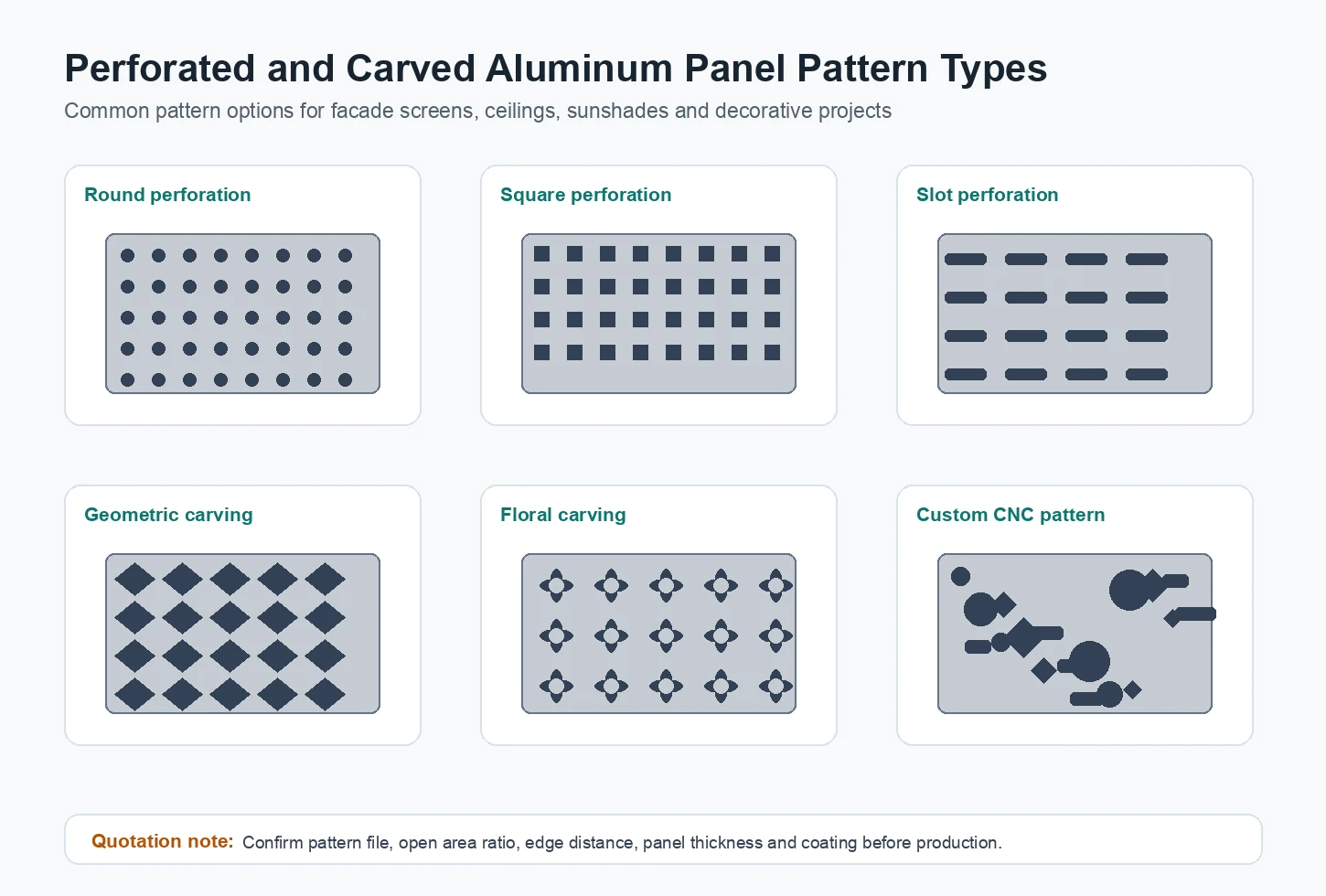
| Pattern Type | Typical Use | Buyer Notes |
|---|---|---|
| Round perforation | Facades, ceilings, ventilation panels | Easy to repeat and quote |
| Square perforation | Modern facades and screens | Clean geometric appearance |
| Slot perforation | Sunshade, ventilation, linear design | Direction and spacing matter |
| Geometric carving | Hotels, offices, commercial screens | CAD drawing required |
| Floral carving | Decorative screens and cultural projects | Pattern scale must be checked |
| Custom CNC pattern | Brand identity and special projects | Requires drawing confirmation |
The pattern directly affects price, fabrication difficulty, panel strength, waste ratio, and production time.
Material and Structure
Most perforated and carved aluminum panels are made from aluminum solid sheet.
A typical panel may include:
| Component | Function |
|---|---|
| Aluminum sheet | Main panel body |
| Surface coating | Provides color, weather resistance, and decorative finish |
| Perforation or carving | Creates ventilation, shading, privacy, or decorative effect |
| Folded edge | Improves panel rigidity and installation connection |
| Stiffener or reinforcement | Helps control flatness for larger panels |
| Fixing bracket or clip | Connects panel to subframe |
For larger panels, folded edges and stiffeners are important for panel rigidity and final flatness.
Fabrication Process
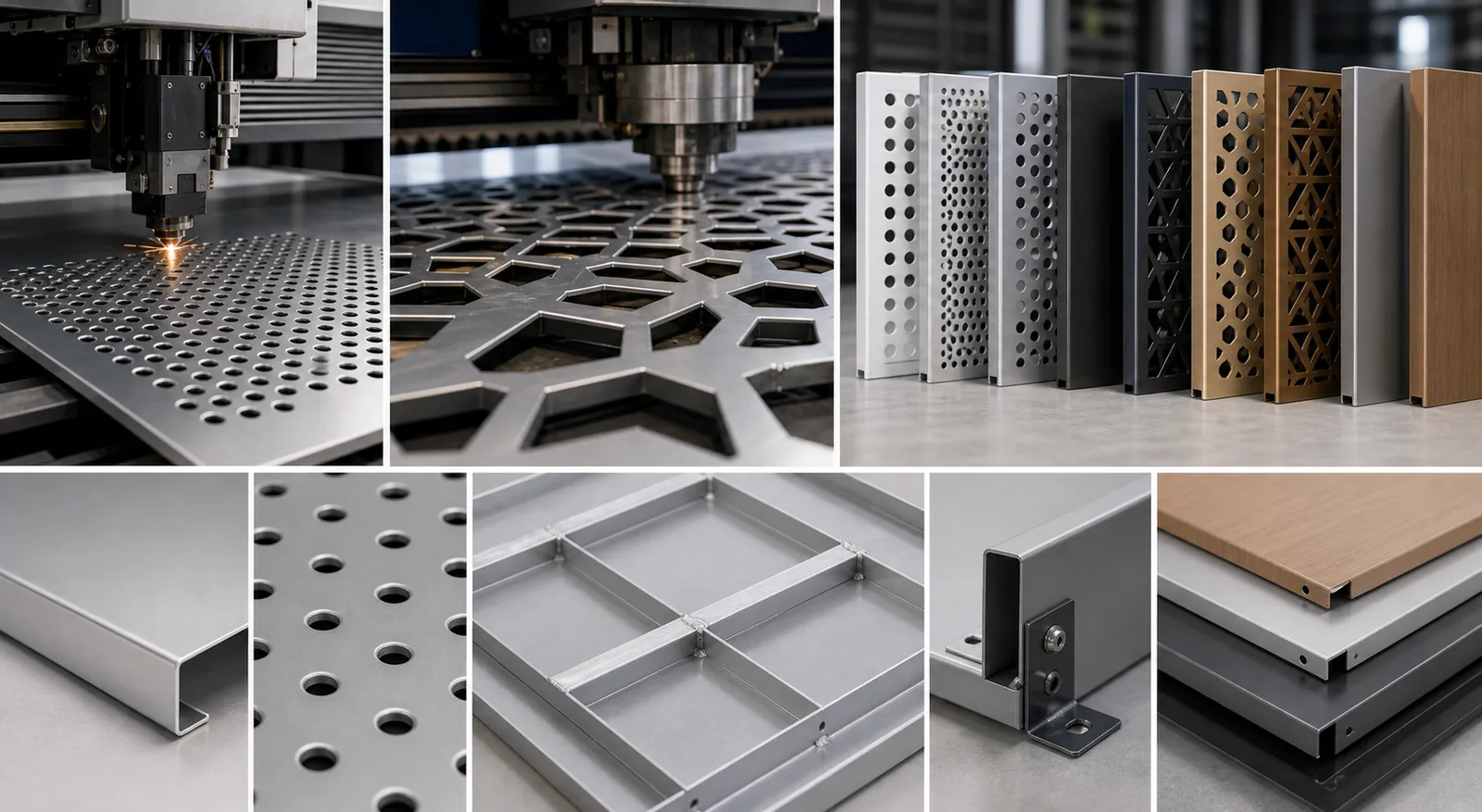
A typical fabrication process includes:
- Drawing confirmation
- Pattern layout optimization
- Aluminum sheet cutting
- Punching, CNC cutting, or laser cutting
- Folding and edge return
- Welding or reinforcement if needed
- Surface treatment
- Quality inspection
- Protective film and export packing
Before production, buyers should confirm the drawing, panel size, pattern scale, edge return, coating color, and installation method.
For custom patterns, production should not start only from a reference photo. CAD drawing or vector pattern file is strongly recommended.
Key Engineering Considerations
| Item | Why It Matters |
|---|---|
| Panel thickness | Affects strength, flatness, cost, and weight |
| Hole size | Affects ventilation, appearance, and panel strength |
| Open area ratio | Affects shading, privacy, airflow, and structural stability |
| Pattern distance from edge | Prevents weak edges and fabrication problems |
| Folded edge size | Affects installation and panel rigidity |
| Stiffener design | Helps large panels remain flat |
| Coating system | Must match indoor or outdoor environment |
| Subframe accuracy | Affects final alignment and joint appearance |
Wind load, structural strength, fire rating, coating warranty, and installation safety must be confirmed with project drawings, supplier data, and test reports where required.
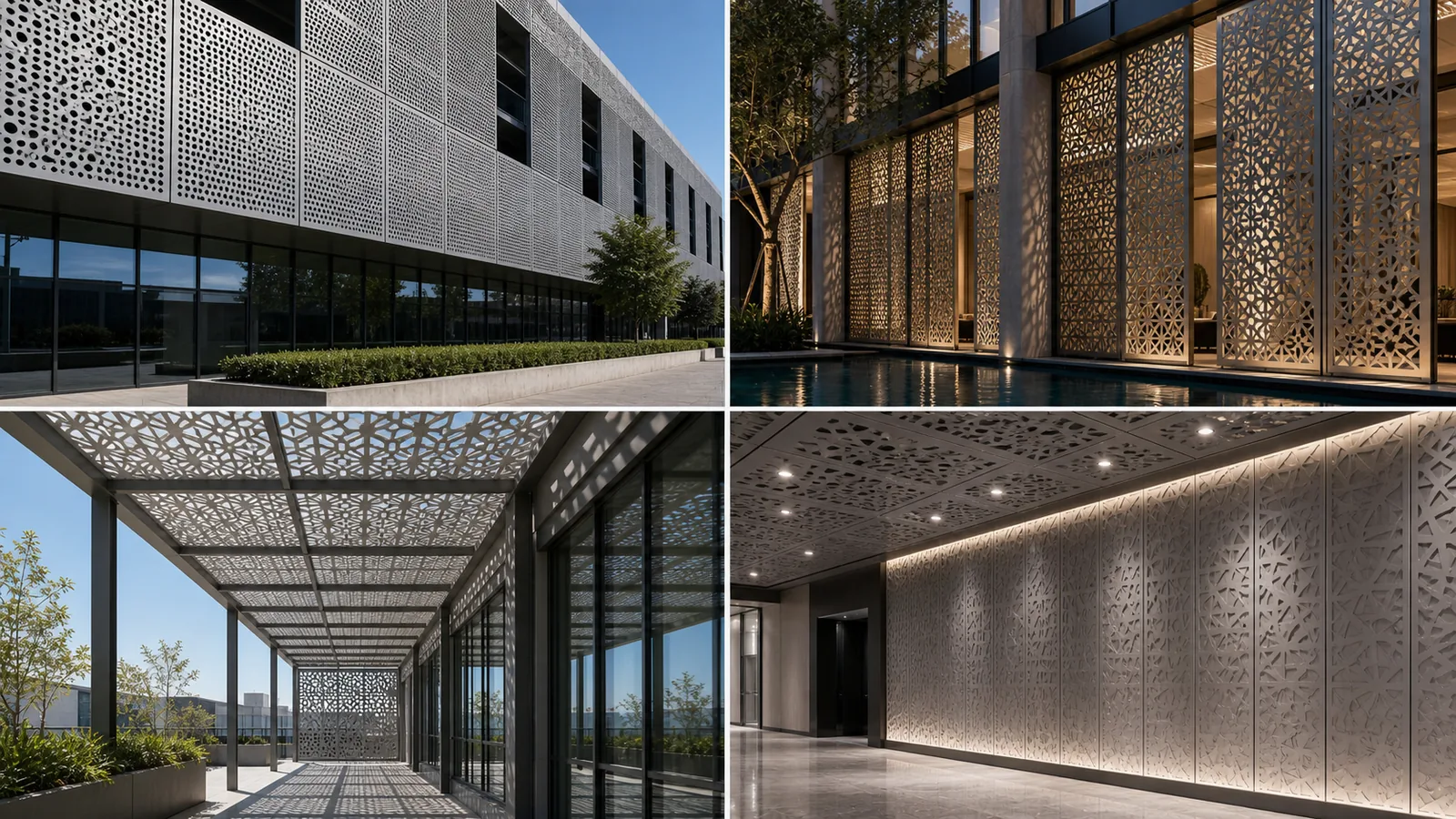
Application Scenarios
| Project Type | Perforated Aluminum Panel | Carved Aluminum Panel |
|---|---|---|
| Commercial facade | Excellent | High |
| Hotel decorative screen | High | Excellent |
| Parking garage facade | Excellent | Medium |
| Sunshade panel | Excellent | High |
| Privacy screen | High | Excellent |
| Interior feature wall | High | Excellent |
| Decorative ceiling | Excellent | High |
| Balcony screen | High | Excellent |
| Cultural building facade | Medium | Excellent |
| Equipment enclosure | Excellent | Medium |
Choose perforated aluminum panel when ventilation, repeated pattern, shading, or lower visual weight is important.
Choose carved aluminum panel when custom design, cultural pattern, privacy screen, or strong decorative effect is more important.
Installation System and Project Details
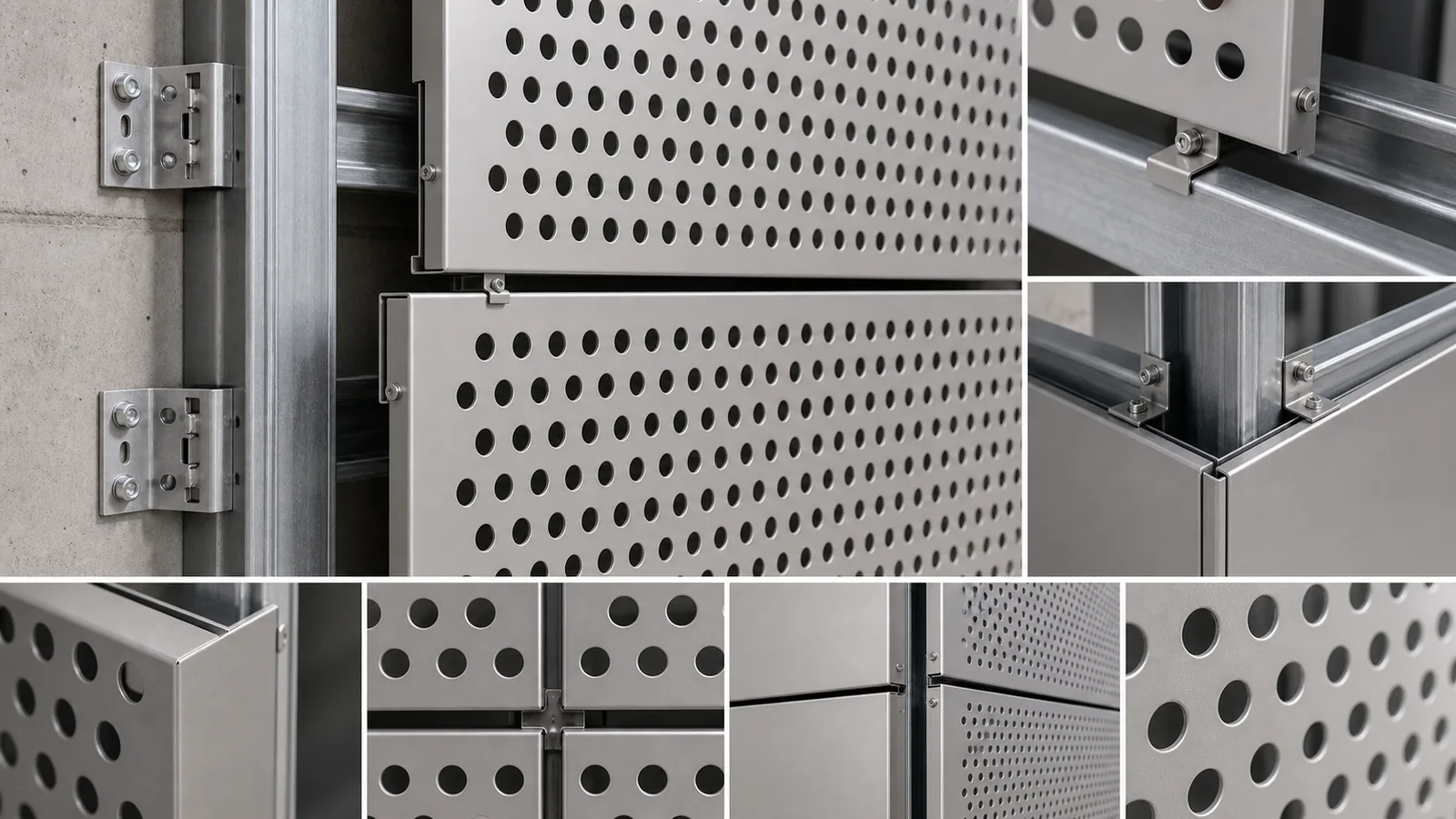
Perforated and carved aluminum panels are usually installed on a metal subframe.
1. Facade Screen Installation
Common system:
- Steel or aluminum subframe
- Brackets or clips
- Folded panel edges
- Open joints or designed gaps
- Panel numbering
Key points:
- Subframe accuracy affects final alignment
- Panel joints should match facade design
- Hole pattern direction must be controlled
- Large panels may need stiffeners
2. Ceiling Installation
Common system:
- Ceiling suspension frame
- Hook-on or clip-in fixing system
- Modular panel layout
- Lighting and access panel coordination
Key points:
- Panel weight must match suspension system
- Lighting openings should be planned before production
- Pattern direction affects final ceiling appearance
3. Decorative Screen Installation
Common system:
- Frame or post system
- Hidden fixing or visible screw fixing
- Edge reinforcement
- Modular screen panels
Key points:
- Screen height and wind exposure should be considered
- Pattern should not weaken the panel too much
- Edge frame and fixing points should be confirmed
Common Project Risks
Many problems in perforated and carved aluminum panel projects come from unclear drawings or incomplete quotation details.
Common risks include:
- Buyer sends only a reference photo without CAD drawing
- Open area ratio is not confirmed
- Panel thickness is too thin for the pattern size
- Pattern is too close to panel edge
- Stiffeners are not included in quotation
- Subframe and fixing method are not coordinated
- Coating system is not suitable for outdoor environment
- Pattern direction is inconsistent between panels
- Color is confirmed only by photos
- Packaging does not protect perforated or carved edges
- Installation accessories are missing from quotation
For export orders, buyers should confirm drawings, pattern file, panel size, thickness, coating, edge return, fixing system, packing, and sample before mass production.
How to Choose Between Perforated and Carved Aluminum Panel
| Buyer Requirement | Recommended Product |
|---|---|
| Ventilation facade | Perforated Aluminum Panel |
| Parking garage facade | Perforated Aluminum Panel |
| Repeated hole pattern | Perforated Aluminum Panel |
| Sunshade with airflow | Perforated Aluminum Panel |
| Hotel decorative screen | Carved Aluminum Panel |
| Privacy screen | Carved Aluminum Panel |
| Cultural or custom pattern | Carved Aluminum Panel |
| Strong visual identity | Carved Aluminum Panel |
| Interior feature wall | Carved Aluminum Panel or perforated panel depending on design |
| Acoustic ceiling or wall | Perforated Aluminum Panel with acoustic backing if required |
The correct choice depends on project design, open area, privacy requirement, airflow requirement, budget, and installation system.
Perforated / Carved Aluminum Panel vs Other Aluminum Panels
| Material | Best Use | Main Advantage |
|---|---|---|
| Perforated Aluminum Panel | Facades, ceilings, ventilation, sunshade | Ventilation and repeated pattern design |
| Carved Aluminum Panel | Decorative screens and custom facades | Strong custom visual effect |
| Aluminum Solid Panel | Facades, folded panels, curved panels | Fabrication flexibility |
| Aluminum Honeycomb Panel | Large flat walls and ceilings | Lightweight, rigid, and flat |
| Aluminum Ceiling Panel | Indoor ceilings and corridor systems | Modular ceiling installation |
Perforated and carved aluminum panels are usually part of the aluminum solid panel family because they are processed from solid aluminum sheet. For broader material selection, compare Aluminum Solid Panel vs Aluminum Honeycomb Panel.
What Buyers Should Confirm Before Quotation
Before requesting a quotation, please prepare the following information:
- Project type: facade, screen, ceiling, sunshade, wall, balcony, hotel, commercial building, etc.
- Product type: perforated aluminum panel or carved aluminum panel
- Indoor or outdoor use
- Total area in square meters
- Panel size or layout drawing
- Aluminum thickness
- Pattern file or CAD drawing
- Hole size, spacing, or open area ratio if perforated
- Edge return size
- Stiffener requirement
- Surface finish and color
- Coating requirement: PVDF, powder coating, polyester, wood grain, etc.
- Installation system
- Packing requirement
- Destination country and port
- Sample requirement before bulk order
Clear information helps suppliers quote accurately and prevents misunderstanding between different fabrication requirements.
FAQ
What is perforated aluminum panel?
It is an aluminum sheet panel processed with holes or slots for facade, ceiling, ventilation, sunshade, and decorative applications.
What is carved aluminum panel?
It is an aluminum sheet panel processed with decorative cut-out patterns, usually by CNC cutting or laser cutting according to project drawings.
Which is better, perforated or carved aluminum panel?
It depends on the project. Perforated aluminum panel is better for ventilation and repeated pattern facades. Carved aluminum panel is better for custom decorative screens and visual identity.
Can perforated aluminum panel be used outdoors?
Yes, it can be used outdoors if the correct aluminum thickness, coating system, fixing method, and project engineering requirements are confirmed.
Do I need CAD drawings?
For custom perforated or carved aluminum panels, CAD drawings or vector pattern files are strongly recommended before quotation and production.
What affects the price?
Price is affected by aluminum thickness, panel size, pattern complexity, open area ratio, edge return, stiffener, coating, quantity, and packing method.
What information is needed for quotation?
Buyers should provide product type, project drawing, panel size, thickness, pattern file, surface finish, coating requirement, installation method, quantity, and destination port.
Request a Quotation
If you are sourcing perforated aluminum panels, carved aluminum panels, aluminum facade screens, or decorative aluminum panels for a project, please send us your project details.
Please include:
- Project type
- Drawing or pattern file
- Panel size
- Total area
- Thickness requirement
- Surface finish
- Indoor or outdoor use
- Destination country
We can help check suitable aluminum panel options, fabrication method, surface finish, packing method, and factory quotation.
Request Aluminum Panel Quotation
Send your drawings, panel size, thickness, surface finish, quantity and destination port. We can help check suitable aluminum panel options, fabrication details, packing method and factory quotation.