
Aluminum panels are usually project-based building materials. They are widely used for facades, curtain wall cladding, ceilings, soffits, canopies, columns, screens, perforated panels, carved panels, curved panels and decorative wall surfaces.
For small B buyers, contractors, distributors and import starters, three practical questions often come first:
- Can I order a sample?
- What is the MOQ?
- How will the panels be packed for export shipping?
The answer depends on panel type, surface finish, aluminum thickness, color batch, fabrication difficulty, quantity, packing method and destination port.
This guide explains how aluminum panel MOQ, sample orders and export packing usually work, so buyers can prepare better project information before requesting a quotation.
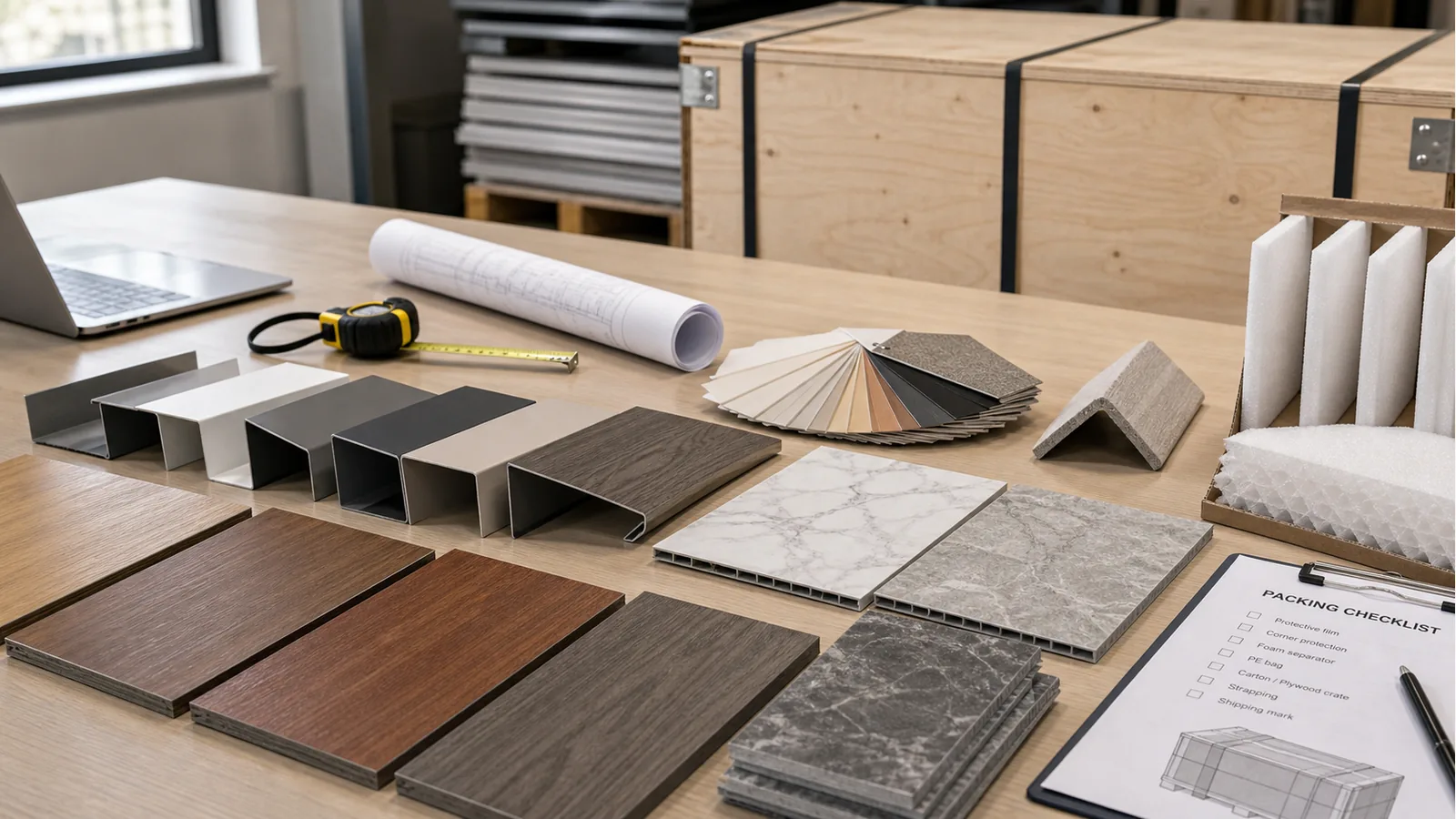
Quick Buyer Summary
| Topic | Buyer Notes |
|---|---|
| MOQ is not fixed | It depends on panel type, coating, color, fabrication, quantity and supplier policy |
| Sample order is useful | Samples help confirm finish, color, coating, edge detail and fabrication quality |
| Color sample is not full product sample | A small color swatch cannot show full panel structure, edge return or installation detail |
| Custom sample may have cost | Sample cost depends on size, finish, mold, fabrication and freight |
| Trial order should be realistic | Very small trial orders may have higher unit price |
| Packing affects final quality | Coating, corners, folded edges, perforation and curved shapes need protection |
| Freight depends on size and destination | Large panels, wooden crates and special shapes affect shipping cost |
| Bulk order should follow approved sample | Sample approval should be connected with final specification and production batch |
Why Aluminum Panel MOQ Is Different
Many buyers ask:
“What is your MOQ for aluminum panels?”
But aluminum panel MOQ is not the same for every product.
A simple powder coated ceiling panel, a PVDF facade panel, a wood grain soffit panel, a perforated screen panel and a curved hyperbolic aluminum panel may have different MOQ logic.
MOQ may be affected by:
- Panel type
- Aluminum thickness
- Surface coating
- Color and finish batch
- Panel size
- Edge return
- Stiffener requirement
- Perforation or carving
- Curved or special-shaped fabrication
- Production setup
- Packing method
- Trial order quantity
- Destination and shipping method
For this reason, buyers should not only ask for “MOQ.” They should describe the product type, finish, quantity, size and project use.
Factors That Affect Aluminum Panel MOQ
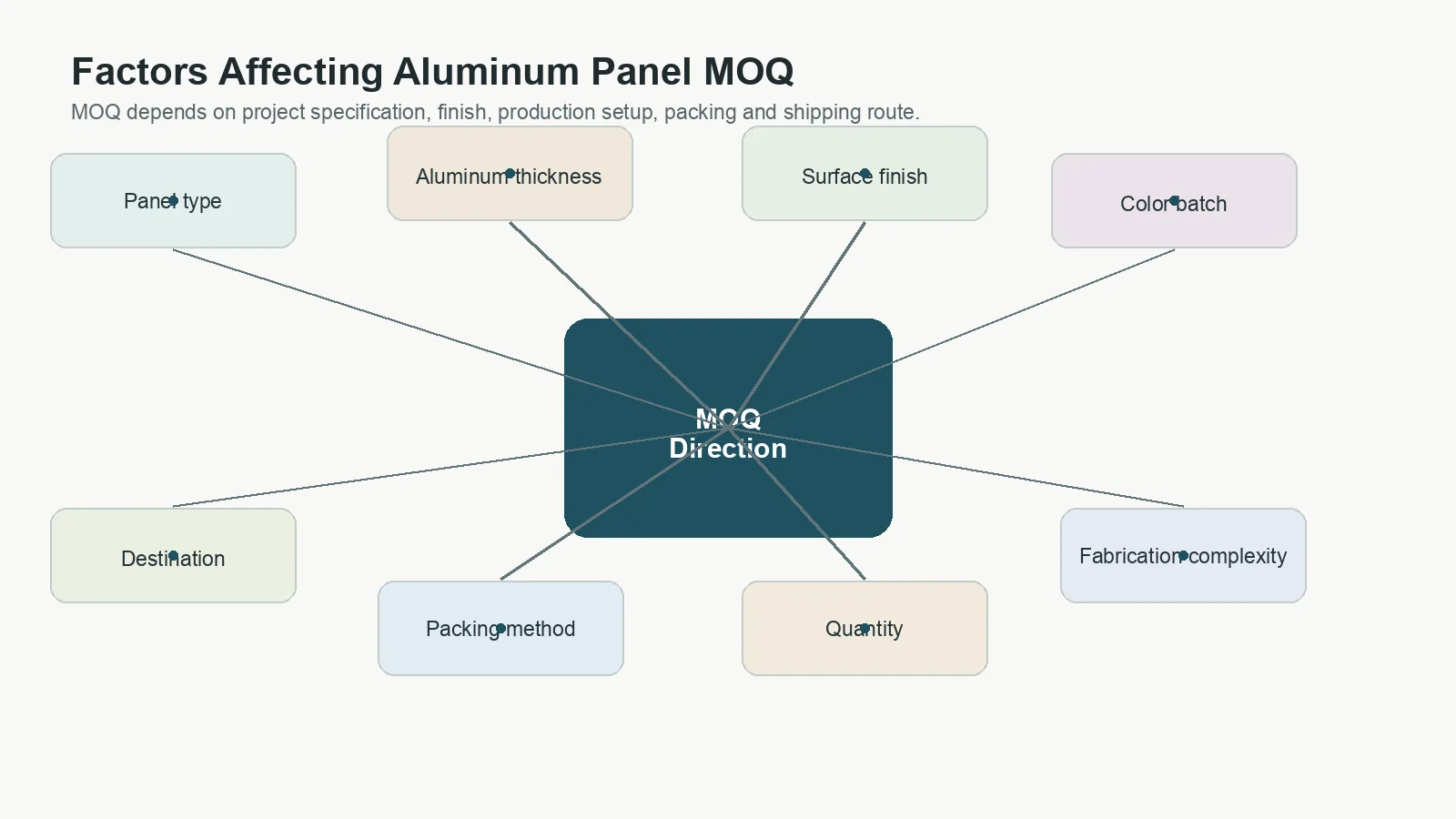
| Factor | Why It Affects MOQ |
|---|---|
| Panel type | Solid panel, honeycomb panel, ceiling panel and curved panel require different production processes |
| Aluminum thickness | Different thicknesses may require different sheet preparation and fabrication setup |
| Surface finish | PVDF, powder coating, wood grain, stone look and metallic finishes have different batch logic |
| Color batch | Custom colors may need minimum coating quantity |
| Panel size | Large panels affect production, packing and shipping |
| Fabrication complexity | Perforation, carving, edge return, stiffener and curved forming increase setup work |
| Sample requirement | Sample size and finish affect sample cost and preparation time |
| Packing method | Wooden crates, foam separation and special protection add cost |
| Destination | Shipping route and freight method affect trial order feasibility |
A low MOQ may be easier for standard products and common colors.
A higher MOQ may be needed for custom color, special coating, large-size panels, curved panels or complicated fabrication.
Common Aluminum Panel Order Types
| Order Type | Typical Use | Buyer Notes |
|---|---|---|
| Color sample | Confirm surface finish and color | Good for early finish selection |
| Small fabrication sample | Confirm edge return, folding, coating and detail | Useful before larger project order |
| Trial order | Test product, packing and shipping | Unit price may be higher |
| Project order | Real facade, ceiling or wall project | Better for custom production |
| Distributor starter order | Build local sample library or showroom | Should include selected product range |
| Bulk order | Large project or repeat purchase | Should follow approved sample and final drawings |
For small buyers, a sample or trial order is often the first practical step.
What Sample Should Buyers Request?
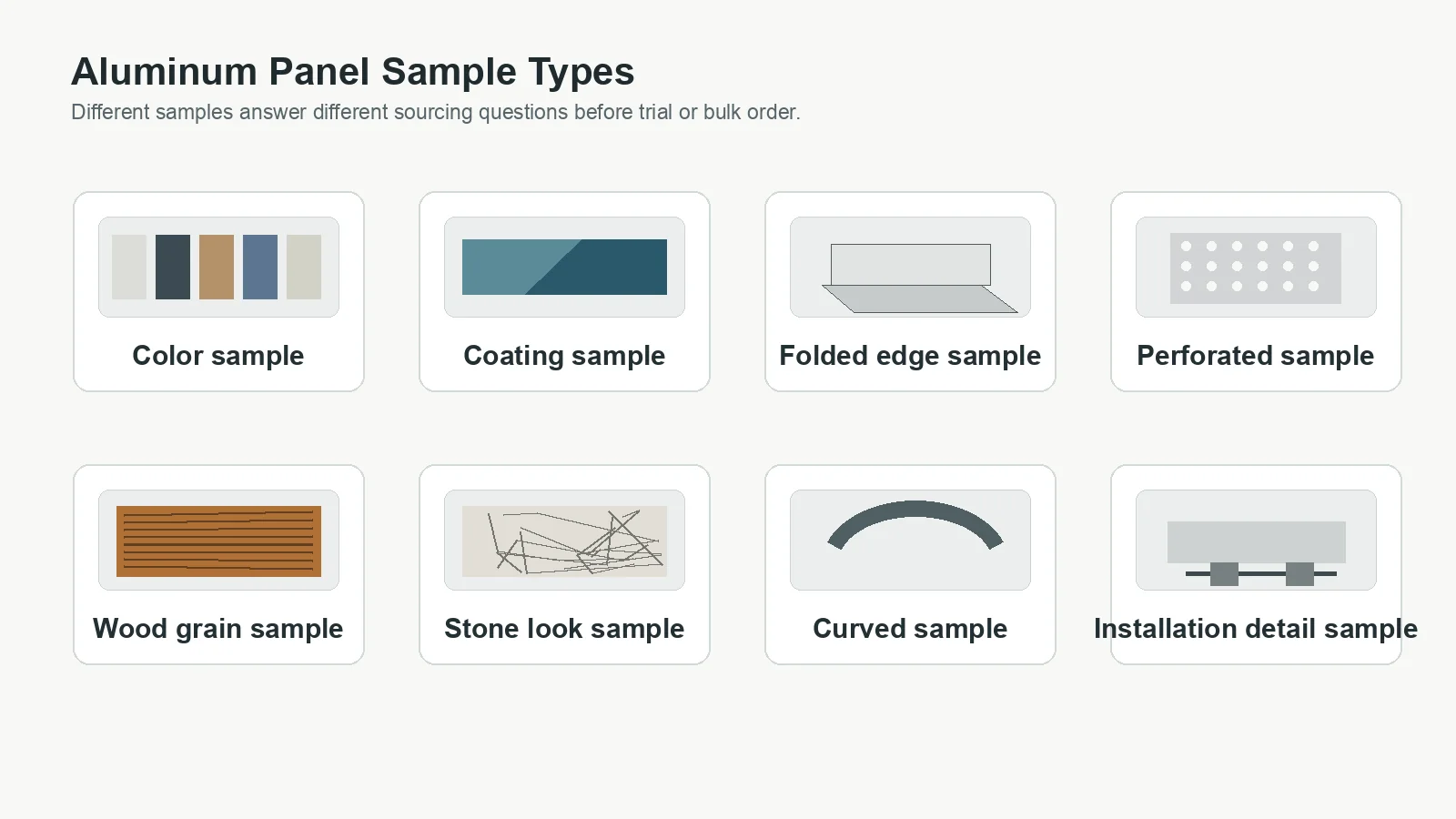
Different samples have different purposes.
| Sample Type | What It Shows | What It Cannot Fully Show |
|---|---|---|
| Color sample | Color, gloss, finish appearance | Full panel structure or edge detail |
| Coating sample | Coating effect and surface texture | Final panel size and installation method |
| Folded edge sample | Edge return and corner treatment | Full facade layout |
| Perforated sample | Hole size, pattern and coating quality | Full panel strength or large pattern effect |
| Wood grain sample | Texture and color direction | Large-area batch consistency |
| Stone look sample | Pattern and gloss | Large wall pattern scale |
| Curved sample | Radius and forming effect | Full project geometry |
| Installation detail sample | Bracket, joint and fixing concept | Full site installation condition |
If the project is only at early design stage, color samples may be enough.
If the project is near ordering stage, fabrication sample or mock-up sample may be more useful.
Sample Order Workflow
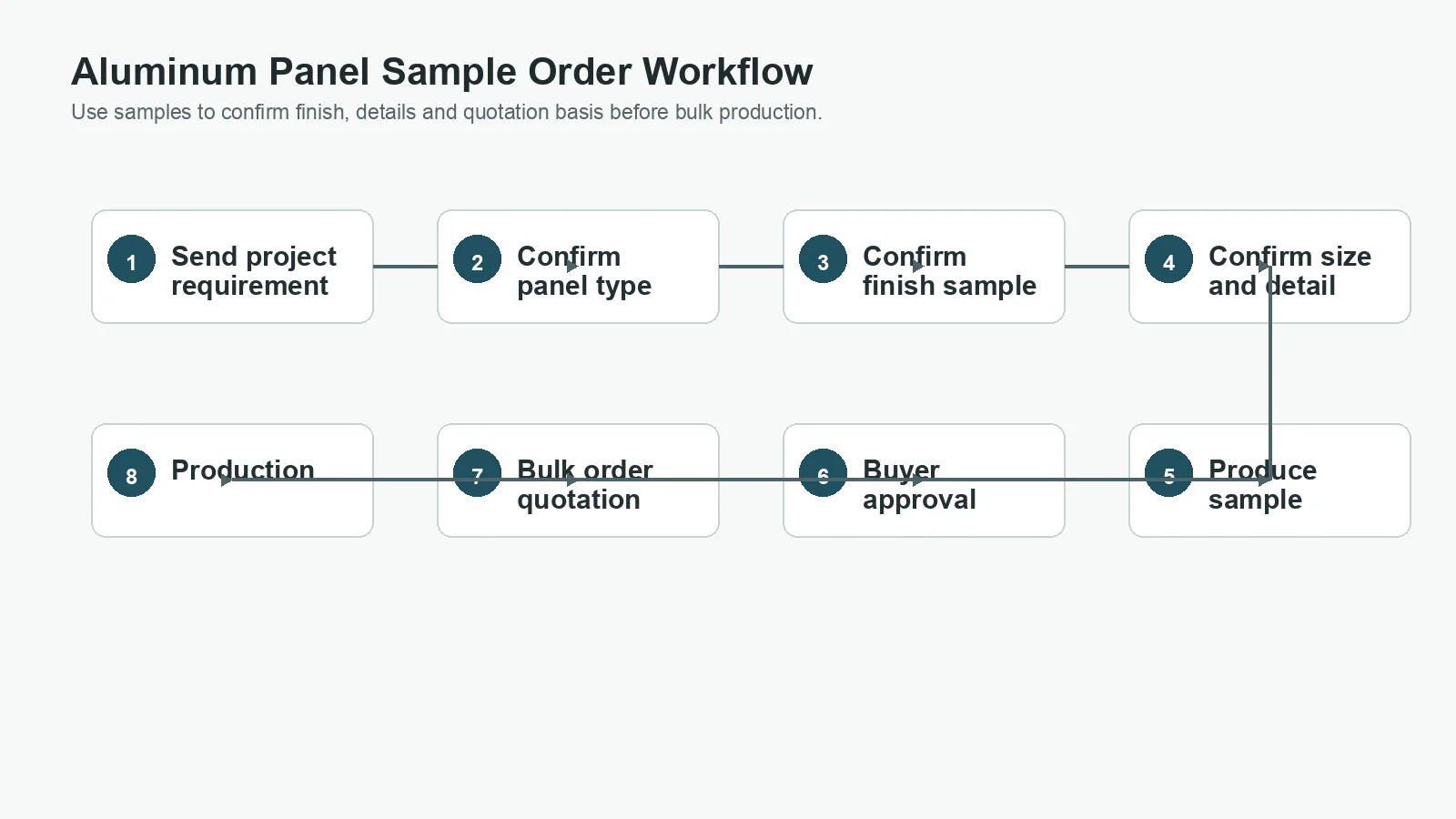
A practical sample order workflow may include:
- Buyer sends project requirement
- Supplier confirms product type
- Buyer confirms finish or color sample
- Supplier confirms sample size and detail
- Supplier quotes sample cost and freight
- Sample is produced
- Buyer checks color, finish and detail
- Buyer gives feedback or approval
- Final quotation is prepared based on approved specification
- Bulk order follows approved sample and drawings
Sample approval should not be separated from final order specification.
If the sample is approved but bulk order uses another color, coating, thickness or panel detail, the result may be different.
Sample Cost and Freight
Sample cost depends on:
- Sample size
- Surface finish
- Coating type
- Custom color requirement
- Edge return
- Perforation or carving
- Curved shape
- Packaging
- International courier or air freight
Some suppliers may provide small standard samples with low cost or free sample policy, but freight and custom samples often need to be confirmed separately.
Buyers should ask clearly:
- Is the sample free or charged?
- Is freight included?
- What size is the sample?
- Is it a color sample or fabrication sample?
- Is the sample from current production batch?
- Can the sample be used as approval reference for bulk order?
Trial Order vs Bulk Order
A trial order is useful when the buyer wants to test:
- Product quality
- Packing method
- Export process
- Surface finish
- Local market feedback
- Installation response
- Supplier communication
But trial orders may have higher unit cost because setup, packing and shipping are spread over smaller quantity.
| Order Type | Advantage | Limitation |
|---|---|---|
| Sample order | Low risk for finish checking | Cannot test full project cost |
| Trial order | Tests product and shipping | Higher unit price |
| Bulk order | Better production efficiency | Requires confirmed drawings and specification |
| Repeat order | Better communication and consistency | Requires stable demand |
For project-based aluminum panels, trial order should still be based on realistic product specification.
Why Export Packing Matters
Aluminum panels are often shipped over long distances.
Poor packing can damage:
- Coating surface
- Folded edges
- Corners
- Perforated patterns
- Curved shapes
- Wood grain or stone look finish
- Panel labels
- Installation sequence
Export packing is not just a shipping detail. It affects final installation quality and customer satisfaction.
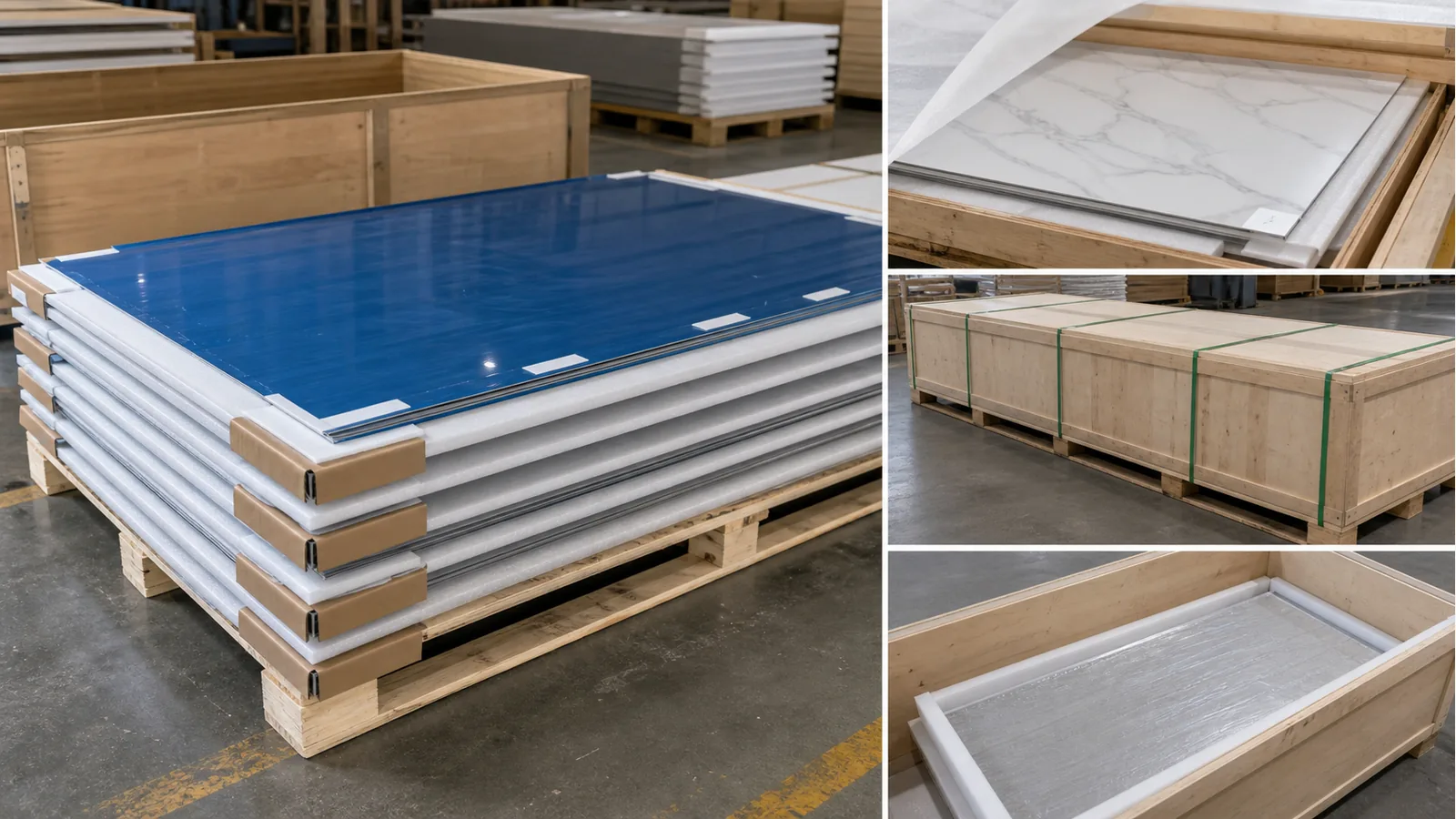
Common Export Packing Methods
| Packing Method | Typical Use | Buyer Notes |
|---|---|---|
| Protective film | Coated aluminum surface | Film should match coating and removal timing |
| Foam separation | Between panels | Helps reduce surface scratching |
| Corner protection | Folded panels and large panels | Protects vulnerable corners |
| Edge protection | Folded edges and special shapes | Important for facade panels |
| Wooden crate | Export shipment | Stronger protection for long-distance shipping |
| Pallet packing | Standard panels | Easier handling and loading |
| Panel numbering label | Custom panels | Helps installation sequence |
| Packing list | Export coordination | Helps site team identify panels |
The packing method should match panel type and shipping distance.
Packing Protection for Different Aluminum Panels
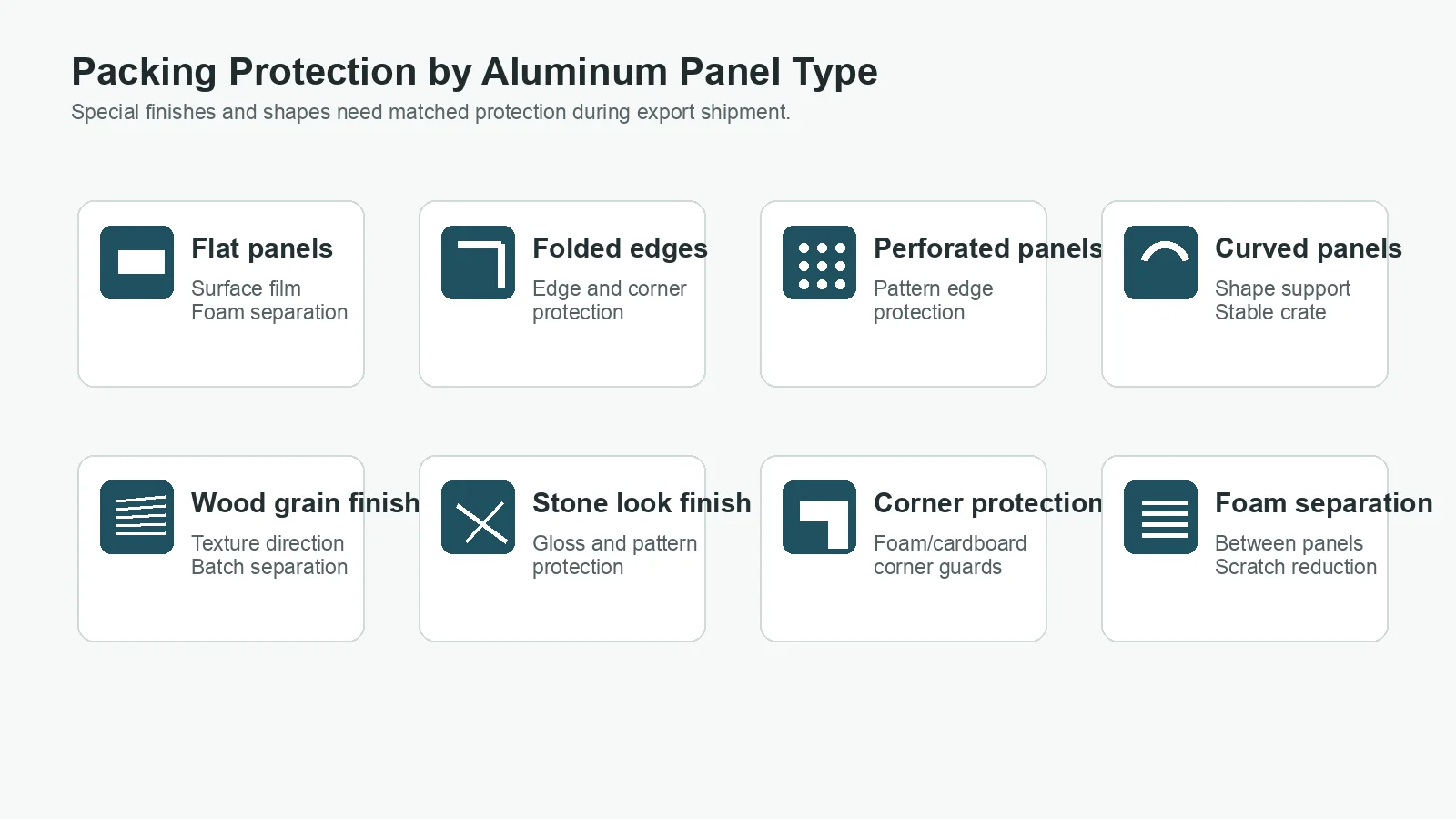
| Panel Type | Packing Focus |
|---|---|
| Flat aluminum panels | Surface protection and panel separation |
| Folded facade panels | Edge return, corners and coating protection |
| Perforated panels | Pattern edge protection and deformation prevention |
| Carved panels | Cut edge protection and surface protection |
| Curved panels | Shape protection and stable crate support |
| Hyperbolic panels | Unique shape and panel numbering protection |
| Wood grain panels | Texture surface and batch separation |
| Stone look panels | Pattern surface and gloss protection |
| Ceiling panels | Module edge and surface protection |
| Honeycomb panels | Corner, edge frame and large panel flatness protection |
Special-shaped panels should not be packed like simple flat sheets.
Panel Numbering and Packing Sequence
For custom aluminum panel projects, packing should consider installation sequence.
Good packing should include:
- Panel number
- Elevation or floor zone
- Panel size
- Finish code
- Packing group
- Crate number
- Installation area
- Packing list
This is especially important for facade projects, curved panels, hyperbolic panels, perforated screen panels, wood grain panels, stone look panels, large ceiling projects and column cladding projects.
If panels are packed randomly, the installation team may waste time finding the correct panels on site.
Coating and Finish Protection
Decorative aluminum panels require careful surface protection.
Buyers should pay attention to:
- Protective film quality
- Surface scratch risk
- Foam separation
- Gloss finish protection
- Wood grain direction labels
- Stone look pattern labels
- Metallic finish direction
- Handling instructions
- Moisture protection if required
Protective film should be removed according to supplier recommendation. Removing it too early or too late may cause problems depending on site condition and film type.
Common MOQ, Sample and Packing Mistakes
Common mistakes include:
- Asking MOQ without giving product type
- Comparing sample price with bulk order price
- Approving color from phone photos only
- Thinking a color sample represents full panel quality
- Ordering bulk production without confirming edge return
- Ignoring packing cost
- Not confirming whether wooden crate is included
- Forgetting destination port
- Not checking whether freight is included
- Not labeling panels by installation sequence
- Treating curved panels like flat panels for packing
- Not keeping approved sample for comparison
- Using a different coating or batch after sample approval
Most of these problems can be reduced by clear communication before order.
What Buyers Should Prepare Before Asking MOQ or Sample Price
Before asking for MOQ, sample or trial order, buyers should prepare:
- Product type: solid panel, honeycomb panel, ceiling panel, perforated panel, curved panel, etc.
- Application: facade, ceiling, soffit, wall, screen, column, canopy, etc.
- Indoor or outdoor use
- Approximate quantity or area
- Panel size
- Thickness
- Surface finish
- Color or sample reference
- Edge return or fabrication detail if needed
- Sample type needed: color sample, fabrication sample, mock-up sample
- Packing requirement
- Destination country and port
- Shipping method preference if known
Clear information helps suppliers give a realistic MOQ and sample quotation.
Sample Request Message for Buyers
Buyers can use this message:
“We are interested in aluminum panels for [facade / ceiling / soffit / screen / wall / column] project. The estimated quantity is about [area or pieces]. Required panel type is [aluminum solid panel / honeycomb panel / ceiling panel / perforated panel / curved panel]. Finish is [PVDF / powder coating / wood grain / stone look / metallic], color reference is [color code or sample photo]. Please advise MOQ, sample options, sample cost, packing method and freight estimate to [destination country / port].”
FAQ
What is the MOQ for aluminum panels?
MOQ depends on panel type, finish, color, thickness, fabrication, supplier policy and project quantity. Standard products and common colors may have lower MOQ, while custom finishes or special-shaped panels may need higher MOQ.
Can I order aluminum panel samples before bulk order?
Yes, sample orders are commonly used to confirm color, coating, finish, edge detail and fabrication quality before bulk order.
Are aluminum panel samples free?
It depends on supplier policy, sample type, sample size, finish and freight. Small standard samples may be easier to provide, while custom samples usually require cost confirmation.
What is the difference between color sample and fabrication sample?
A color sample shows finish and color. A fabrication sample can show edge return, folding, perforation, coating and installation detail.
Why is trial order unit price higher?
Small orders have production setup, packing and shipping costs spread over a smaller quantity, so the unit price may be higher than bulk order.
How are aluminum panels packed for export?
Common methods include protective film, foam separation, corner protection, edge protection, wooden crate or pallet packing, panel labels and packing lists.
How do I reduce shipping damage risk?
Use suitable packing, confirm panel protection method, label custom panels clearly, choose appropriate crate design and communicate handling requirements before shipment.
What information is needed for sample quotation?
Buyers should provide product type, finish, color reference, sample size, fabrication requirement, quantity, destination and shipping method if known.
Request Aluminum Panel MOQ, Sample or Packing Quotation
If you are preparing an aluminum panel sample order, trial order or project order, please send your requirement.
Please include:
- Product type
- Application
- Quantity or estimated area
- Panel size
- Thickness
- Surface finish
- Sample requirement
- Packing requirement
- Destination country and port
We can help check suitable aluminum panel options, MOQ direction, sample method, export packing and factory quotation.