
Aluminum Panel Fabrication Details
Aluminum panel projects are not made from flat sheets alone.
For aluminum facade panels, soffit panels, ceiling panels, perforated panels, carved panels, curved panels and column cladding, details such as edge folding, edge return, corner treatment, stiffeners, fixing holes, bracket coordination and panel size can directly affect quotation, production quality, installation accuracy and final appearance.
For overseas contractors, distributors, architects and project buyers, understanding these fabrication details helps avoid wrong quotation comparison, missing accessories, flatness problems, installation delays and site rework.
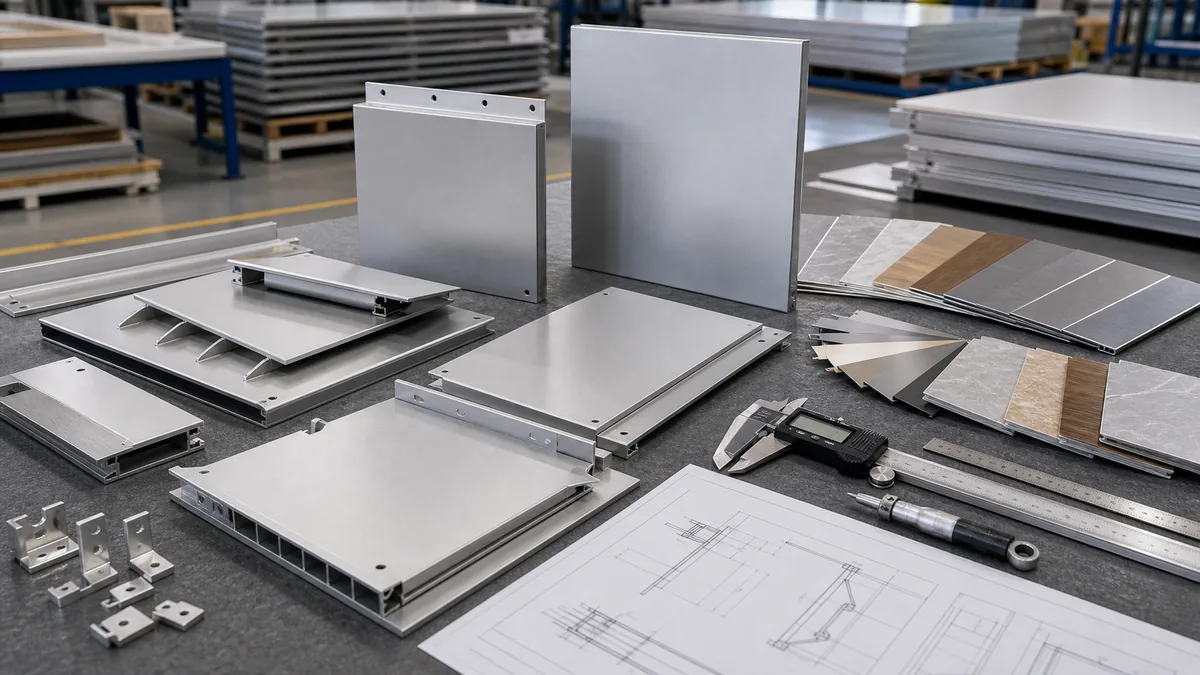
Quick Buyer Summary
| Fabrication Detail | Why It Matters |
|---|---|
| Edge return | Improves panel rigidity and creates fixing area |
| Folded edge depth | Affects panel depth, installation method, cost and packing size |
| Corner treatment | Affects appearance, strength, water path and production time |
| Stiffener | Helps larger panels maintain flatness and shape stability |
| Fixing holes | Must match brackets, clips, screws and subframe position |
| Panel size | Affects flatness, fabrication difficulty, transport and installation |
| Coating direction | Important for metallic, wood grain and stone look finishes |
| Packing protection | Protects folded edges, corners, coating and special shapes during shipment |
| Shop drawings | Confirm all fabrication details before production |
Why Edge Folding Matters
Many buyers compare aluminum panels only by thickness and square meter price.
But in real facade and ceiling projects, edge folding is one of the most important fabrication details.
Edge folding can affect:
- Panel rigidity
- Fixing method
- Installation speed
- Joint appearance
- Corner finishing
- Panel depth
- Packing size
- Flatness control
- Final facade quality
A flat sheet without folded edges is not the same as a finished aluminum facade panel with edge return, stiffeners, fixing holes and bracket details.
This is why two aluminum panels with the same visible size and thickness may have different prices.
What Is Edge Return?
Edge return means the folded side edge of an aluminum panel.
It turns a flat aluminum sheet into a box-like panel shape, creating depth, rigidity and fixing space.
Common edge return dimensions depend on panel design, project requirements and installation system.
Edge return is important for:
- Facade panels
- Curtain wall cladding
- Soffit panels
- Ceiling panels
- Column cladding
- Canopy panels
- Perforated panels
- Curved aluminum panels
The correct edge return should be confirmed in shop drawings before production.
Common Edge Return and Corner Types
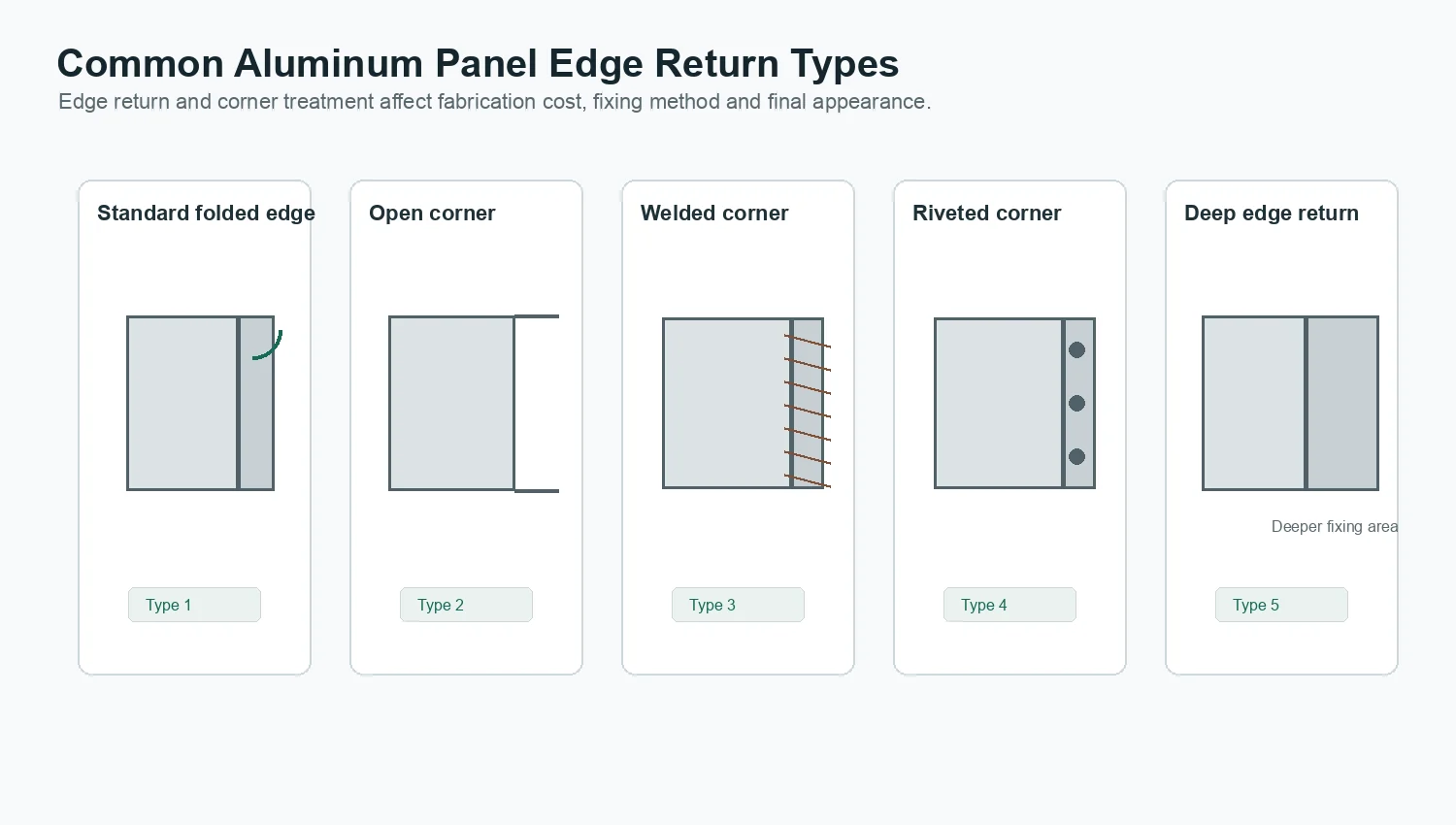
| Detail Type | Typical Use | Buyer Notes |
|---|---|---|
| Standard folded edge | Normal aluminum facade and wall panels | Common fabrication detail for solid aluminum panels |
| Open corner | Some cost-sensitive or hidden edge areas | Must confirm whether visible or hidden |
| Welded corner | Higher appearance requirement or exposed corners | Requires welding and polishing, affects cost |
| Riveted corner | Some practical panel systems | Faster than welding but visible detail must be accepted |
| Deep edge return | Facade panels needing stronger fixing or deeper panel system | Affects panel depth, packing and price |
| Special edge return | Curved, perforated, carved or ceiling panels | Must match installation system |
Corner treatment should not be ignored. Many facade problems happen at corners and edges, not in the center of the panel.
Edge Return Depth and Quotation Difference
Edge return depth can affect price because it changes fabrication work and material usage.
A deeper edge return may require:
- More aluminum material
- More folding work
- More careful corner treatment
- Larger packing space
- Different fixing bracket
- Different installation depth
When buyers request quotation, they should confirm whether the price includes edge return and what edge return depth is used.
A quotation for flat sheet price and a quotation for finished folded aluminum panel price are not the same.
What Is an Aluminum Panel Stiffener?
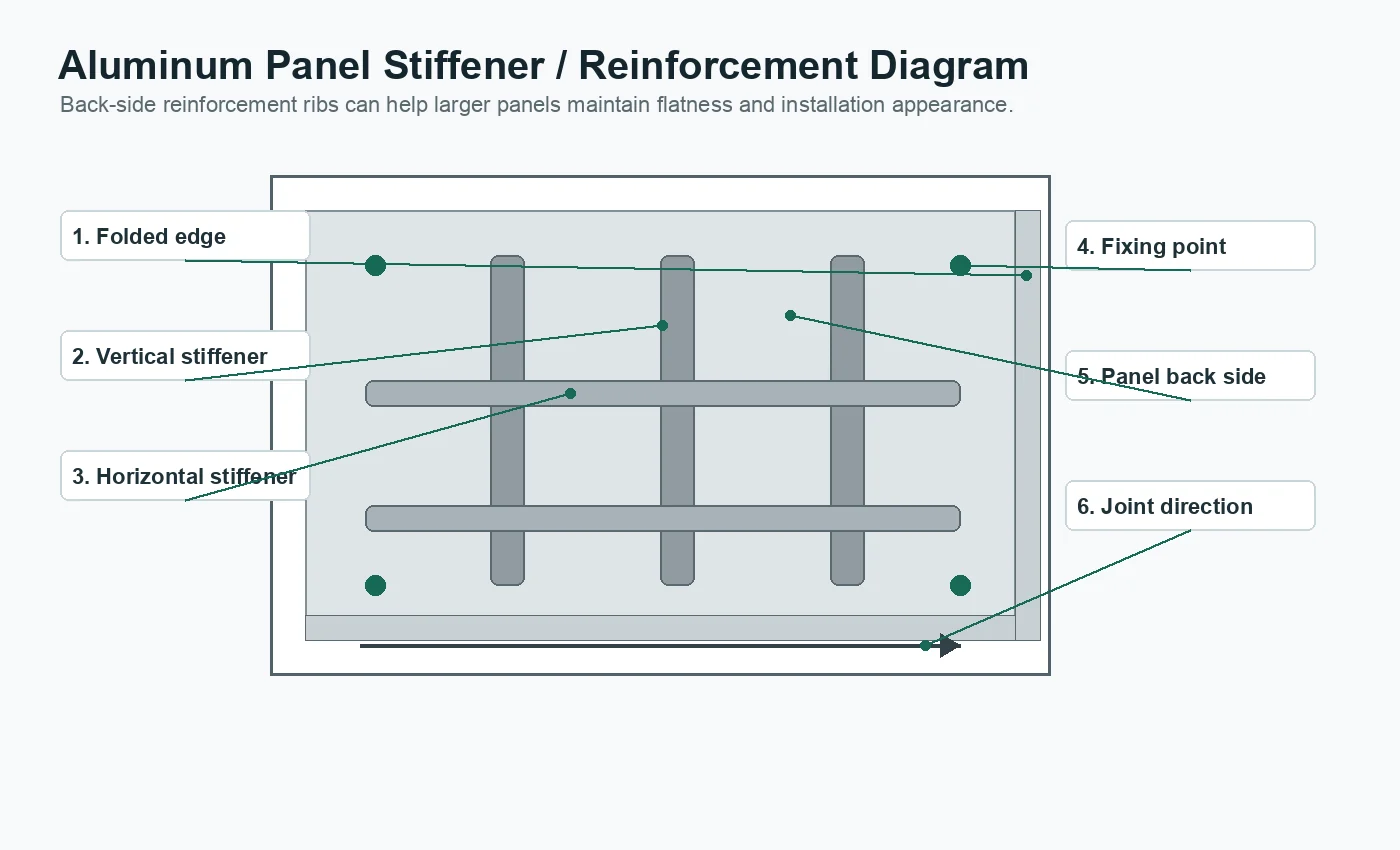
A stiffener, also called reinforcement rib, is a reinforcing component installed on the back side of an aluminum panel.
It helps improve panel stability and reduce deformation risk, especially for larger panels.
Stiffeners may help with:
- Panel flatness
- Shape stability
- Resistance to visible waviness
- Installation alignment
- Long-term appearance
- Large panel control
Stiffener design should be coordinated with panel size, thickness, installation system and project requirements.
Whether stiffeners are required should be confirmed according to project drawings, panel size, local code, engineering review and supplier recommendation.
When Are Stiffeners Usually Needed?
Stiffeners may be considered when:
- Panel size is large
- Aluminum thickness is not enough for panel size
- Exterior facade requires better flatness
- Wind exposure must be considered
- Panel is long and narrow
- Panel has many perforations or cut-outs
- Panel is curved or special-shaped
- Panel has high visual appearance requirement
- Installation system needs additional support
Not every panel needs stiffeners.
But if a large facade panel is quoted without stiffeners, buyers should ask whether flatness and installation appearance have been considered.
Panel Size, Flatness and Stiffener Selection
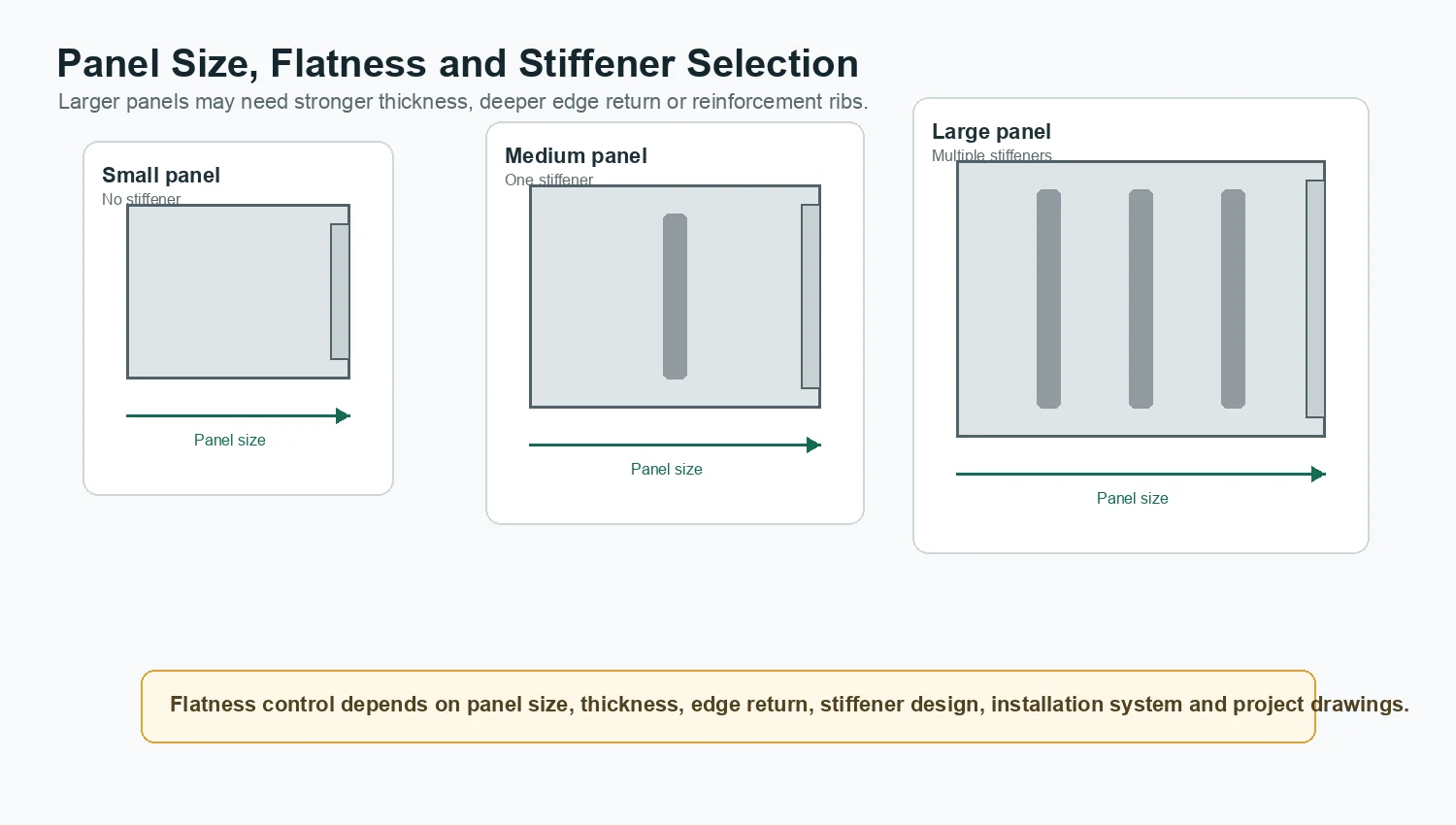
Panel size affects fabrication and installation risk.
| Panel Condition | Common Concern | Possible Solution |
|---|---|---|
| Small panel | Usually easier to control | Standard edge return may be enough |
| Medium panel | Flatness and joint alignment need checking | Edge return and selected stiffeners may be used |
| Large panel | Higher risk of waviness or deformation | Larger thickness, deeper edge return or stiffeners may be needed |
| Long narrow panel | May twist or deform | Stiffener direction and fixing method should be checked |
| Perforated panel | Open area reduces panel strength | Thickness, edge distance and stiffener should be confirmed |
| Curved panel | Shape control is more difficult | Radius, forming method and reinforcement should be reviewed |
A good quotation should not only give a square meter price. It should also consider whether the panel size and fabrication details are reasonable.
Fixing Holes and Bracket Coordination
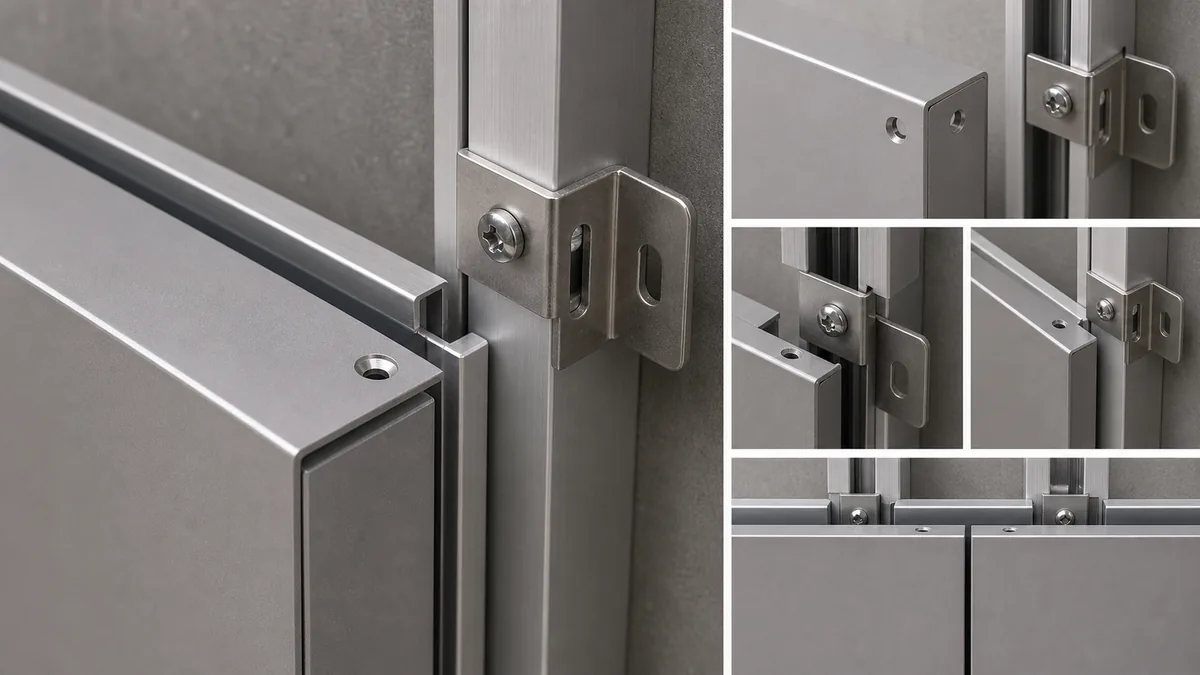
Fixing holes should match the installation system.
Before fabrication, buyers and suppliers should confirm:
- Bracket type
- Clip type
- Screw or rivet position
- Hole position
- Hole size
- Edge return depth
- Subframe position
- Installation tolerance
- Open joint or sealed joint
- Panel numbering
If fixing holes do not match the bracket or subframe, the site team may need to drill or modify panels on site. This can damage coating, delay installation and reduce final appearance quality.
Edge Folding for Different Aluminum Panel Types
Different aluminum panel types need different edge details.
| Panel Type | Edge / Stiffener Focus |
|---|---|
| Aluminum solid panel | Folded edge, edge return, stiffener, fixing holes |
| Aluminum honeycomb panel | Edge closing, frame detail, skin thickness and fixing system |
| Perforated aluminum panel | Edge distance, open area, reinforcement and pattern direction |
| Carved aluminum panel | Cutting edge, pattern strength, edge frame and packing protection |
| Curved aluminum panel | Radius, folded edge feasibility, stiffener and panel numbering |
| Hyperbolic aluminum panel | 3D shape, edge detail, unique panel code and subframe coordination |
| Aluminum ceiling panel | Module edge, clip-in or hook-on detail, carrier system |
| Aluminum soffit panel | Edge closing, drainage, ventilation and exterior coating system |
| Wood grain aluminum panel | Edge return plus texture direction control |
| Stone look aluminum panel | Edge return plus pattern scale and layout control |
The edge detail should match the product type, not only the material name.
Fabrication Workflow
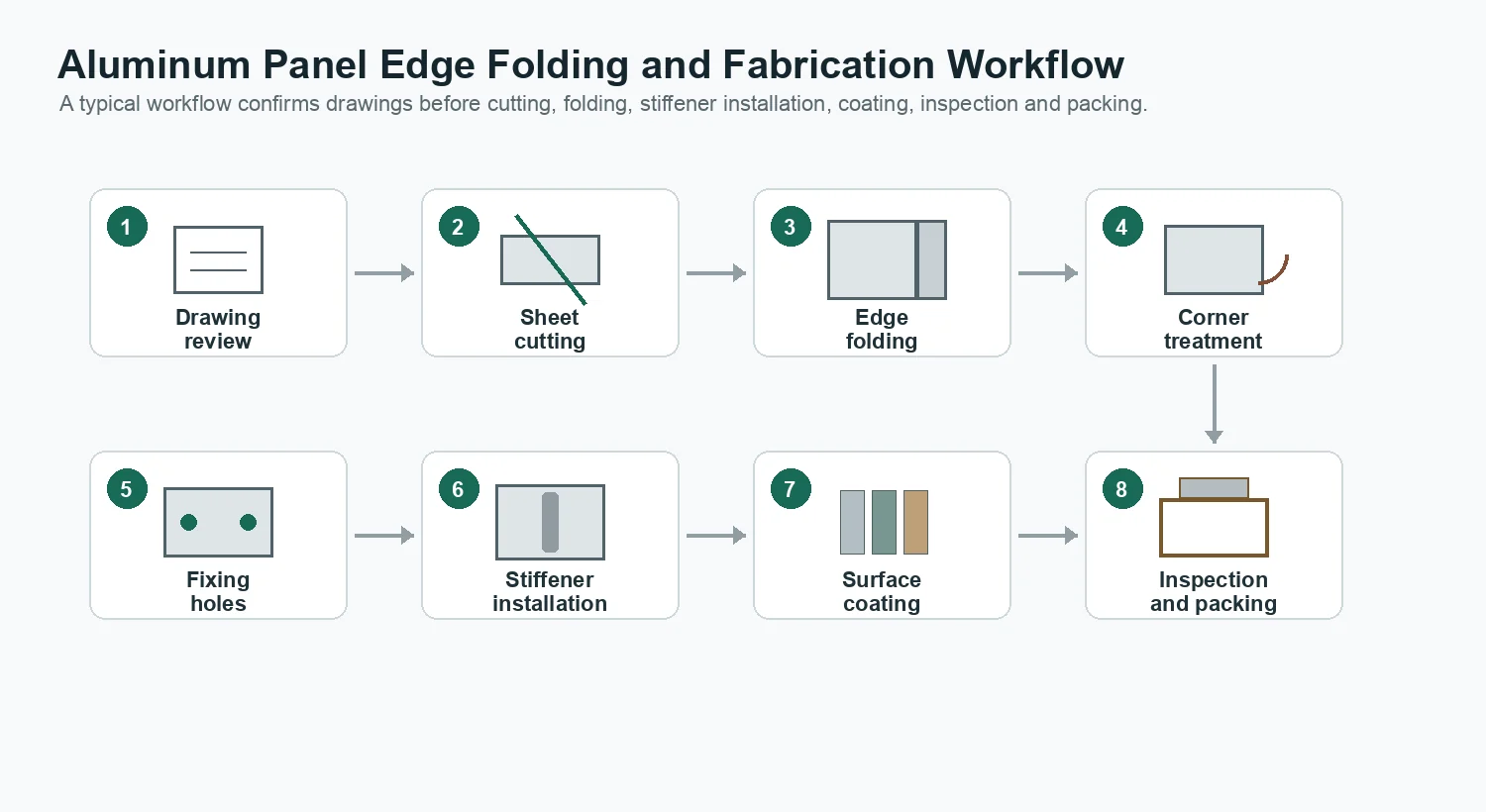
A typical aluminum panel fabrication workflow may include:
- Drawing review
- Panel schedule confirmation
- Aluminum sheet cutting
- Edge folding
- Corner treatment
- Fixing hole preparation
- Stiffener installation
- Welding or polishing if required
- Surface pretreatment
- Coating or finishing
- Quality inspection
- Protective film and packing
For custom aluminum panels, drawing confirmation should happen before fabrication.
For coated aluminum panels, buyers should also confirm whether holes, folding, welding and polishing are completed before coating or after coating, depending on production process and project requirement.
Corner Treatment
Corner detail can affect both appearance and cost.
| Corner Type | Typical Use | Notes |
|---|---|---|
| Open corner | Hidden or low-visibility areas | Lower cost, but not suitable for all visible panels |
| Welded corner | Exposed facade or premium appearance | Better appearance but more labor |
| Riveted corner | Practical fixing or certain panel systems | Visible rivet detail should be accepted |
| Folded corner | Some standard panels | Depends on panel design and equipment |
| Special corner | Column, canopy, curved or irregular panels | Requires drawing confirmation |
If the corner is visible after installation, buyers should confirm the expected finish before production.
Surface Coating and Folding Detail
Surface finish must be coordinated with fabrication sequence.
For aluminum panels, common finishes include:
- PVDF coating
- Powder coating
- Polyester coating
- Wood grain finish
- Stone look finish
- Metallic finish
- Anodized or brushed finish depending on project
Important points:
- Coating direction should be marked if visible
- Wood grain direction must be controlled
- Stone pattern layout should be approved
- Metallic finish may show direction and color difference
- Protective film should not hide quality problems during inspection
- Folding after coating may damage surface if process is not suitable
Buyers should confirm physical samples and coating system before bulk production.
Packing Protection for Folded Panels
Folded aluminum panels are easier to damage at corners and edges than flat sheets.
Export packing should consider:
- Protective film
- Foam separation
- Corner protection
- Edge protection
- Stiffener protection
- Panel numbering
- Packing by installation zone
- Wooden crate or pallet
- Moisture protection if required
- Loading sequence
For perforated, carved, curved or high-gloss panels, stronger packing may be required.
Common Fabrication and Installation Risks
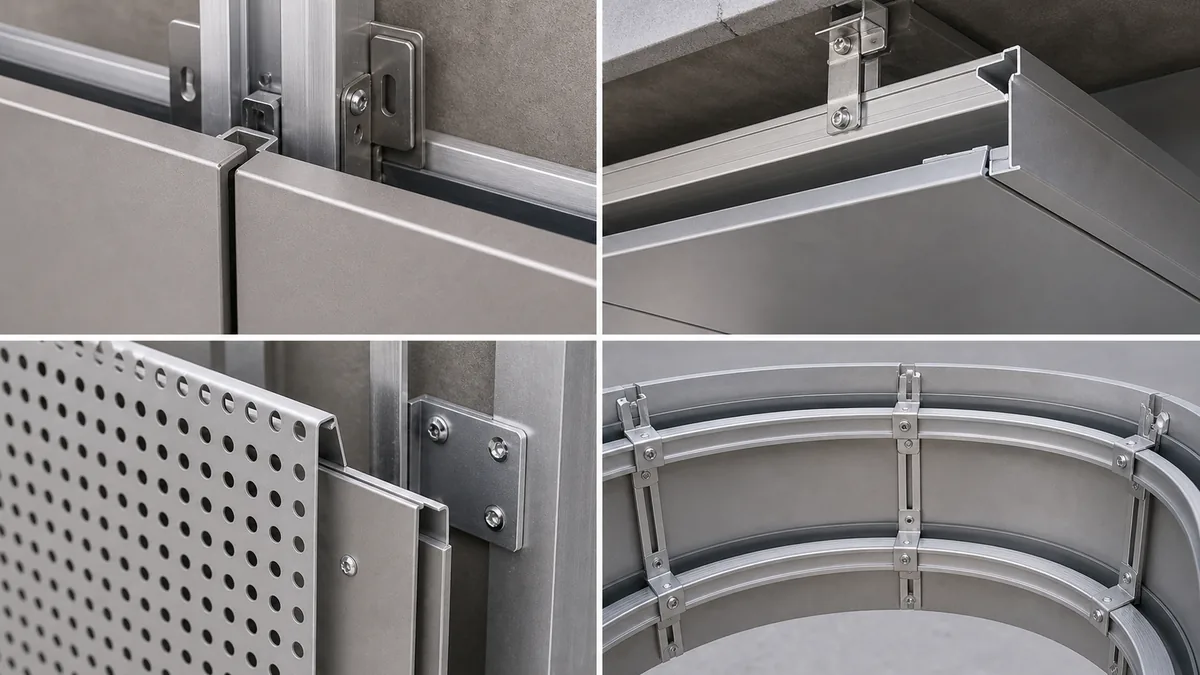
Common risks include:
- Buyer compares flat sheet price with finished folded panel price
- Edge return depth is not confirmed
- Corner treatment is not shown in drawings
- Stiffeners are missing from quotation
- Fixing holes do not match brackets
- Panel size is too large without flatness control
- Perforated panel edge distance is too small
- Curved panel radius is not confirmed
- Wood grain direction is not marked
- Coating is scratched during handling
- Packing does not protect folded edges
- Site team modifies panels after coating
- Shop drawings are not approved before production
Most of these problems can be reduced by confirming drawings, edge details, stiffeners and installation system before production.
How Edge Folding Affects Aluminum Panel Price
Aluminum panel price may be affected by:
- Aluminum thickness
- Panel size
- Edge return depth
- Folding complexity
- Corner welding or polishing
- Stiffener quantity
- Fixing hole preparation
- Perforation or carving
- Curved forming
- Surface coating
- Packing method
- Quantity and production difficulty
This is why a professional quotation should specify the fabrication details, not only material thickness and area. Buyers can also review the aluminum facade panel quotation guide before comparing prices.
What Buyers Should Confirm Before Quotation
Before requesting quotation, buyers should prepare:
- Project type: facade, ceiling, soffit, canopy, screen, column, etc.
- Product type: solid panel, honeycomb panel, perforated panel, curved panel, ceiling panel, etc.
- Drawings or reference photos
- Panel size or layout
- Aluminum thickness
- Edge return depth
- Corner treatment requirement
- Stiffener requirement
- Fixing hole or bracket requirement
- Surface coating and color
- Indoor or outdoor use
- Installation system if known
- Packing requirement
- Destination country and port
- Sample or mock-up requirement
If the buyer does not know the exact edge return or stiffener requirement, the supplier can review drawings and suggest a suitable direction.
Sample Message for Buyers
FAQ
What is edge return in aluminum panels?
Edge return is the folded side edge of an aluminum panel. It improves rigidity and creates a fixing area for installation.
Why do aluminum panels need folded edges?
Folded edges help create panel depth, improve rigidity, support fixing, and create cleaner panel joints.
What is an aluminum panel stiffener?
A stiffener is a reinforcement rib installed on the back side of a panel to help improve flatness and shape stability.
Does every aluminum panel need stiffeners?
No. Stiffener requirement depends on panel size, thickness, application, installation system and project requirement.
Why does edge folding affect price?
Edge folding affects material usage, fabrication labor, corner treatment, packing size and installation method.
Can fixing holes be drilled on site?
It is better to coordinate fixing holes before fabrication. On-site drilling may damage coating and cause installation problems.
What information is needed for quotation?
Buyers should provide drawings, panel size, thickness, edge return, corner treatment, stiffener requirement, surface finish, installation method, packing requirement and destination port.
When folded panels use decorative surfaces, buyers should also confirm wood grain and stone look finish direction because edge returns and panel joints affect the final appearance.
Folded aluminum panels need careful crate design and edge protection. See the packing protection guide for folded aluminum panels before confirming trial orders.
Request Fabrication Detail Review
Send your drawings, panel size, thickness, surface finish, quantity and destination port. We can help check suitable aluminum panel options, fabrication details, packing method and factory quotation.